Do What Needs To Be Done!

Piggy backing on Monday’s post let’s do what needs to be done!

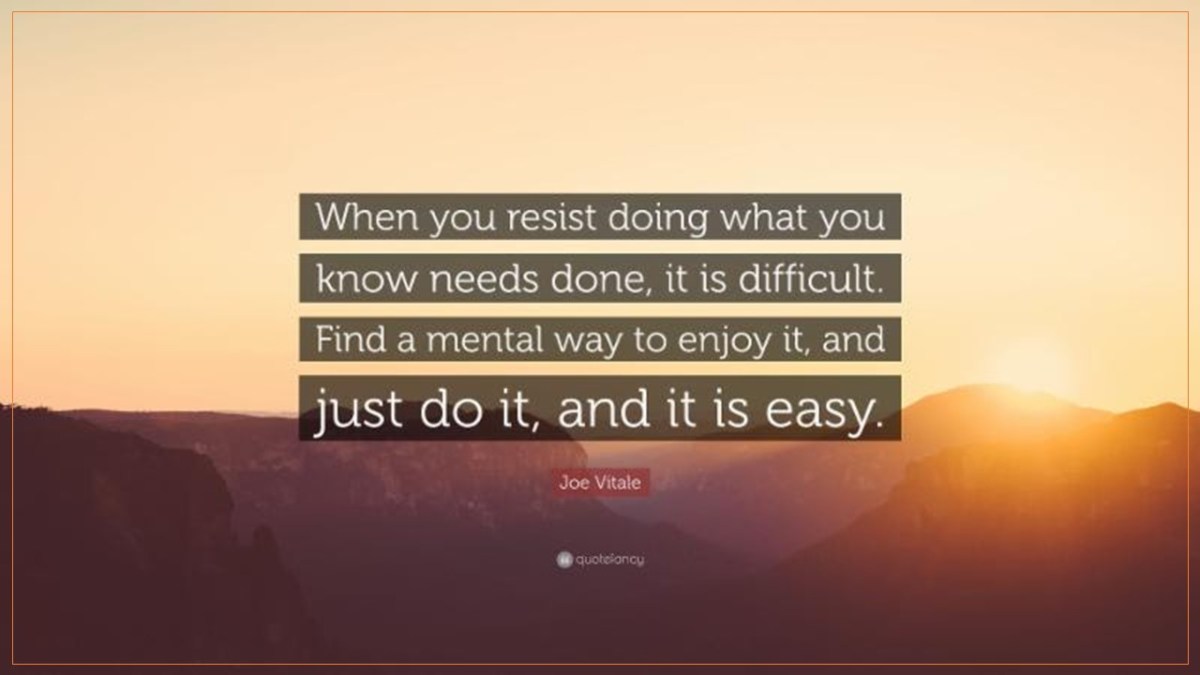
There is work you need to do, but you resist that work. You know you need to do this work, how to do this work, the importance of doing it, and when it needs to be done. Yet, that work sits, not yet started and nowhere near finished, the source of your procrastination unknown and unresolved.

There are a number of sources of procrastination that, once identified, can be overcome.

Comfort: It is easy to seek comfort over work. Work requires that you lean in, giving what needs to be done your focus and energy. Comfort doesn’t require the same focus or energy. Comfort allows you to lean back and watch Netflix, to be still and passive instead of creating movement and proactivity. Comfort is warm, easy, and seductive. Unless you give yourself over to it, your work may not be any of these.

Entertaining Distractions: You live in an age of infinite distractions, the smallest and largest of which lives in your left hand or your pocket. In any case, it is never more than a few feet away from you. You have news, television, radio, movies, magazines, video games, the internet, cameras, video cameras, online shopping, and countless other distractions vying for your attention. Then there are text messages, emails, phone calls, and notifications. Distractions provide entertainment and escapism, making them something easier than work.

Conflict: You may avoid some of the work that you need to do because you have conflicts around that work. Is it the right work for you to do? Is it something that you should have said no to when asked? Is it something you believe should not be done or should be done some other way? These conflicts can be the root cause of procrastination.

Fear: When work is creative in nature and opens you up to being judged by others, the fear of that judgment can be the source of your procrastination. If the work is great, some may still be critical. If the work is poor, some will still find it valuable. Procrastination prevents you from acting and sharing your gift with the world, making the unattainable goal of perfection so far out of reach so as to make it difficult to start.

For whatever reason, by allowing what most needs to be done to go undone, you move the results you need to produce further away from you, shorten the time you have to do the work, and increase the stress-and the eventual negative consequences of not having done it.

What most needs done is what you most resist. Understand why you resist and do the work that most needs done right now, like closing deals!!

Happy Selling,

David

HUNGER TO SUCCEED

It takes hunger to succeed.

In all my years in the business world, I met a lot of people with amazing talent. I can’t tell you how many times I said “This one is going to be a star.“ 

Unfortunately in most cases, I was proven wrong. They had what it took to be successful except one missing ingredient.

Talent alone is not enough. 

The first thing I look for now is HUNGER. Without hunger, none of the other tangibles matter. 

If you want true success, you have to be hungry.

When someone is hungry for success, you can see it in their eyes. They may not have all the talent in the world but they have that ingredient that’s going to help them succeed. 

When someone is hungry, they are all in. They are going to do what it takes to become successful. 

The word “try” is not in their vocabulary. They are simply just going to do it. Total failure is not an option. There is no Plan B. They are 100% committed to the cause and they are not looking back. That’s the type of hunger that’s necessary in order to have success.

I’ve also found that people that are hungry are committed to constantly improving. 

They are not satisfied with just being average. They may start slow but they understand that if they commit to continuous learning, they are going to keep improving. 

They understand that failure is part of the process and that’s the only way that they are going to keep learning. 

This is why it’s important to look at the big picture with the understanding that with proper commitment, success is going to happen.

Hungry people look for solutions rather than making excuses. When obstacles or challenges do come, these type of individuals will either find a way or they will make one. The road to success will always be under construction. When you commit to making it happen, success will eventually come.

Over the years, I have found in many cases that I want more success for individuals than they want for themselves. 

Some people require that extra push. The exciting thing is that hunger is actually a driver. I don’t have to micromanage the hungry. 

They are so self-motivated that they push themselves harder than I can push them. 

Hunger definitely opens eyes as well. Those that are hungry have a vision to see small windows of opportunity and they turn them into something big. The journey of success is not going to be easy, but when you’re hungry, the commitment is there.

Perhaps you have found yourself lacking that hunger. The good news is you can change that. Write out exactly what you want out of life and be very specific. 

Look at it every day. Have photos. You must have a reason WHY you want to succeed. 

If anyone ever tells you that you don’t have what it takes to be successful, prove them wrong. That’s what I call “being hungry.”
This is your week! This is your time!

Stay hungry!

Happy Selling,

David

DO IT ANYWAY

How serious are you about your success journey?

Far too many people think that the success journey is one straight arrow going up.

The reality is, it’s the exact opposite of that. The success journey is filled with ups, downs, curves etc.

On any given day there will be tons of things that could happen to you that prevent you from feeling like putting in the work that you need to achieve your goals.

Some of these will be just minor distractions while others can be very severe.

That does not mean that you have to stop. You don’t have to procrastinate either. Every single one of us will experience distractions that come our way. They will happen and we can deal with them. The main thing is we have to decide to keep moving forward.

I have found that self motivation is a big key. It is one of the main things that separates high achieving individuals from everyone else. Motivation is personal.

So how do you keep pushing forward on the days when you don’t feel like it?

This applies to everyone because we all go through this in some form or another.

Obviously, setting goals is very important. Make sure that you are designing goals and not chores.

In the field of selling for example, the sales people who set targets close more deals than those that are just wandering aimlessly. It’s

important to make sure your goals are clear and specific. Whatever you are doing, don’t just do it for the money.

Many people unfortunately make the mistake of not enjoying their journey. Yes, we will have difficult days but it is important to have fun.

Focus on the elements of the work that you find enjoyable.
When you do set a goal, make sure that you reward yourself for attaining that goal.
Recognition and incentives go a long way. However, do not choose incentives that undermine the goal you have reached. For example, if you had a great week, I don’t recommend giving yourself the next week to slack off. Keep your momentum going.

There will be days when you are just not feeling it. It could be anything like losing momentum or a few things just did not go your way. This is where accountability comes in.

The worst thing that you can do is reach out to someone that’s not in life where you want to be and have a Complaint session.

Find a mentor and reach out to them and they can walk you through getting back on course. Accountability is a big part of having success. Sometimes you just have to look back and repeat the things that made you successful. Having a good mentor will remind you of that.

There will be days where things don’t go as planned. Life is always filled with unexpected things. It could be very easy to use an excuse that we don’t feel like working. You may not feel like it, but do it anyway. When you pass up on working every time you lose motivation, you will never get to where you need to be in your life.
Push past those feelings and work anyway. Success requires that we put in the hours and the effort needed to accomplish our goals. Beginning is always the hardest part. You must push past the temptation to give up or take time off. Do what you need to do. Your feelings have nothing to do with it. Stay consistent and build momentum.
Happy Selling, 

David

Top 10 Facts You Might Not Know about Easter

Easter — along with all of its decorative eggs, delicious ham dinner and cheerful baskets — is hopping down the bunny trail quicker than the legendary speedy hare. This year, the Christian holiday will fall this Sunday April 9th so get that shopping done if you haven’t already. While the central story of Jesus’ death and resurrection is likely familiar to those who celebrate, there’s a lot of us who might not know about the unique traditions and meaningful symbolism that surrounds this special Sunday. Like Christmas and, to some extent, St. Patrick’s Day and Valentine’s Day, a day that started off as a solely religious observation has taken on tons of secular meaning, so plenty of people who aren’t regular churchgoers enjoy other aspects of the festivities as well. Between the adorable bunny rabbits, spring-forward decorations and large amounts of chocolate, the celebration has evolved over the years with a whole host of customs both new and old. 

So as we always do in David Letterman fashion, from the home office in Eggville, Mississippi, Here are Top 10 Facts You Might Not Know about Easter

10.Easter baskets have special symbolism.

The woven treat containers represent birds’ nests and new life, especially when filled to the brim with eggs. Plus, they’re a pretty utilitarian way to gather those goodies on your Easter egg hunt.

9.There’s a reason you probably eat ham for Easter dinner.

Historically, most early Easter celebrants would have eaten lamb for this special occasion since the holiday has its roots in Jewish Passover. But these days, many American Easter dinners now feature ham instead, because of the timing of the holiday. Years ago, hams cured over the winter months would have been ready to serve in the early spring.

8. Easter lilies are a relatively new tradition.

These beautiful blooms first originated in Japan and arrived in England in the late 18th century. The United States only caught onto the trend after World War I. The transition from dormant bulbs to delicate flowers brings to mind hope and rebirth, two important themes of the Easter celebration.

7. Easter eggs have medieval origins.

Think Easter egg hunts are a strange tradition? Listen to this medieval children’s game: A priest would give one of the choir boys a hard boiled egg, and the boys would pass it amongst themselves until the clock struck midnight, when whoever was holding it got to eat it. We hope they at least got some salt and pepper to go with it.

6. Easter clothes used to be considered good luck.

Old superstition held that if you wore new clothes on Easter, you would have good luck for the rest of the year. In fact, it was so widely believed that upper-class New Yorkers would literally strut their stuff coming out of attending Easter mass at well-heeled midtown churches. This tradition became the basis of the modern, and decidedly less elitist, Easter Parade and Easter Bonnet Festival in New York.

5. Easter eggs date back way before Easter.

There’s evidence showing that Easter eggs originated from Medieval Europe and Christians may not have actually been the ones to start the tradition of giving eggs. They’re a symbol of fertility and rebirth in many cultures around the world.

4. Eggs are dyed to represent the blood of Jesus Christ.

Well, at least that might be one of the reasons, which stems from early Christians in Mesopotamia. There isn’t a concrete reason behind the tradition, but that’s one of the theories. They also look pretty — and kids might be more likely to eat a dyed hard-boiled egg than a plain one!

3. Good Friday is recognized as a holiday in only 12 states.

Occurring two days before Easter Sunday, Good Friday commemorates Jesus Christ’s crucifixion, but it isn’t a federal holiday. Only certain states officially observe it, include New Jersey, North Carolina and Tennessee.

2. We can thank Germany for the bunny.

The idea of the Easter bunny delivering candy and eggs originated in Germany during the Middle Ages, with the first written mention of this tradition dating back to the 16th century. Dutch settlers in Pennsylvania brought the bunny to the United States in the 1700s and the rest is delicious history.

And the #1  Facts You Might Not Know about Easter is …

1. PRETZELS – In the old days, pretzels were associated with Easter.

Why? Because the twists of this salty treat resemble arms crossing in prayer. We say it’s time to bring back this savory snack to the sweets-filled holiday because life is all about balance.

So go ahead and sit down for a delicious brunch this weekend or gather the kids for some fun Easter crafts, Maybe these fun facts will even make great fodder for conversation, insightful Instagram captions or even factoid card tucked into the Easter baskets to give them a little something extra this year. 

Have a Great weekend and a Happy Easter, 

David. 

OVERCOMING COMPLACENCY

I know we talked about this yesterday but I feel more needs to be said on this.

I believe that complacency is something that many deal with at some point or another. I really don’t believe that people enjoy being at a standstill in life. However, complacency can creep up on anyone. 

Complacency is something that can take a toll on self-esteem and overall motivation. It can happen in our relationships, in business, and our overall, every day lives. 

I have certainly seen it in the sales and business world. Representatives come into a new opportunity filled with ambitions and dreams. They set goals and make great accomplishments. Unfortunately, once those goals are achieved, they become comfortable and they start to lose their drive and hunger. This is when they fall into the trap of becoming complacent.

Don’t get me wrong here. I truly believe that it is important to enjoy the fruits of your success. However, it is important that no matter what level that we achieve in life, we must make continued decisions to keep growing and to keep improving. I have learned that progress equals happiness.

Perhaps you have fallen into the trap of becoming complacent. The good news is that today you can change that and get yourself back on track.

The first step is to get your attitude back to being super positive. It’s time to change your mindset. Go back and repeat the things that made you successful.

Remind yourself that you have the awesome ability to overcome this complacency.

Give yourself a pep talk and get yourself pumped back up again. This is also a time to check your inner circle. Remember this, you become who you hang with. Being around people with a growth mindset will help you to get out of this complacency.

The truth is that people become complacent because they stop setting new goals. I see this all the time. They reach their goals and then just stay there. Remember, either you are growing or you are shrinking. It’s time to choose a growth mindset. This is why it’s important to create new positive habits.

For example, start waking up earlier. Get back to working out.  Begin reading positive books and listening to encouraging podcasts. Make a success plan and start becoming organized. Get rid of all the things that are distracting you and start doing the things that will keep you motivated. Most importantly, live every day with gratitude.

Now is the time to set some new goals for your life.

Create some short term and long term goals. Get yourself a new daily journal and start writing out what your goals are for each day, each week and each month. In order to achieve the long-term goals, you must have daily goals.

Stay focused on your plan. Make sure you check frequently to see where you are with your progress. Decide what you want out of life, create a plan and work your tail off to get to the next level in life.

Yes, it is important to be proud of your accomplishments, but you do not want to be the type of person that lives in the past.

Today is a new day and your future looks incredible. You were designed to do even greater things. If you have found yourself becoming complacent, it’s time to get excited about life and your future and your new goals.

Always remember that you were design for growth and greatness. Get your spark back and go out and make it happen! 

Happy Selling,

David

Complacency

This word, complacency.  

This word doesn’t exist in the vocabulary of an entrepreneur.  
We are always looking for opportunities.  To do it better.  Do it faster.  Do it in a different way altogether.  Do something that’s not been done before.  
And if we’re honest, in the payments field, complacency = attrition.  Fail to adapt to the changes and your merchants will adapt without you.  

But because we’re always looking ahead to what’s next, sometimes we fail to recognize the progress we’ve already made, celebrate the achievements we’ve attained, or appreciate the foundation we’ve worked so hard to build.  

We can find ourselves in a never-ending state of uneasiness. 

We always want more.  

We struggle to look back and reflect because we’re too busy chasing the next big idea.  

Take a pause.  Turn your head over your shoulder and see how far you’ve come.That foundation you poured into is what’s supporting the second story you hope to build next.  

Recognize the hard work of getting from zero to something much more, be grateful for what came from it, and then and only then…. Keep building.

Happy Selling, 

David

7 Motivational Tips to Survive in Sales

If you’re going to be in sales you have to stay motivated, and to make motivation a daily part of your life, you need practice and perseverance. Below are seven ways to stock your motivation toolbox. Use these tools daily to keep your spirits and goals on track.

1. Accept where you are. By accepting your own abilities and working within your limitations, you can use valuable energy to create positive life changes. Someone once said, “Your circumstances don’t control you, they define you!” The way you are reflects the sum total of your choices to date.

2. Dare to think in awesome dimensions. When you think about what you want to achieve, do you think of your self-proclaimed limits? Why stop where you stop? Try thinking in unusual or outrageous terms.

3. Don’t dwell on defeat. When you give up in your mind, your mind gives up on you. Once this happens, the rest is downhill. Remember, there is no such thing as failure; there are only outcomes. If you don’t like your outcome, try changing your activity.

4. Tap motivational resources. To counteract negative memories and thoughts, flood your mind with positive input every day by listening to motivational recordings – a podcast or audio book – while working out, on the drive home, on the road, or first thing when you wake up. 

5. Stay committed to your career goals. Salespeople have a tendency to be on the lookout for a better deal. Lack of personal career commitment is the greatest source of dissatisfaction with one’s profession. Get committed and learn to just say no to anything that doesn’t support your career purpose.

High Activity Salespeople (HASPs) Average 50% Higher Sales Commissions!

6. Do not allow setbacks to control you. If you do, then your supporters may think that you don’t have the resolve to stick to your plans for success. When you face an inevitable disappointment, accept it as a learning experience and find creative ways to work through it. You can choose to react to a disappointment by seeking solace and quitting, thus weakening your ability to do something positive about it. Or, instead of shrinking from challenges, you can choose to learn, resolve to handle a similar situation differently the next time around, and grow.

7. Never be intimidated. Most success is more perceived than real. It does no good to envy the possessions of others. There is a teaching in Buddhism: “People are not their stuff.” This means that if you take all of your elements, such as your pride, body, friends, money, status, position, job, and anything else you can think of that you normally use to define another, and remove them from yourself, the real you is left. You are as important as anyone else on the planet.

Remember this saying: “If it is to be, it is up to me.” You have to accept responsibility for getting what you want in your life. When you don’t like a situation, take action to change it. Waiting for someone else to make the changes you want decreases your motivation and ability to act. By waiting, you diminish yourself and your cause. Don’t just take notice, take action.

Happy Selling,

David

NO MORE EXCUSES!

When an amazing opportunity comes up, I see far too many people that come up with all the excuses in the world not to take advantage of the opportunity….

”I’m too old, I’m too young, I don’t know enough, I need more training, I’m waiting for things to be perfect, I wasn’t trained correctly, you don’t know what I’ve been through, etc. etc. etc.”

 This killer disease of success is called “excusitus”.

 Unfortunately far too many people have killed their dreams because of this disease. 

Here’s the good news! 

If you have found yourself making too many excuses, today is the day to change! 

 From here on in, NO MORE EXCUSES! 

Excuses are for the weak. 

Responsibility is for the strong. 

It is time to take responsibility for your life.

 No matter what you have been through, focus on what you can do starting to do to make it better.

 Put together a plan of action to ensure your life will be better in the future.

  Life is too short.

 It is time to make the commitment. 

There is an amazing plan for your life. 

You have been gifted with amazing talent and it’s time to use this God given gift. 

  The road to success is always under construction. 

Nothing is going to go smoothly. 

You will have challenges. 

You will have difficulties. 

Today, you must decide how you are going to respond to those challenges.

 Never give up! 

Never give in!

 Choose to take responsibility for your circumstances. 

Focus on what can be done and choose to make things happen.

  Setbacks are part of the growth process. When challenges come your way, you will keep growing.

 Things will not always go the way that you might have planned. Welcome to life! None of us can escape life‘s challenges and hardships. What separates the winners from the losers is how we respond to life‘s challenges.

  The strong never make excuses. 

Remember, you are strong! 

It is time for you to go to the next level.

 From here on in, no more procrastinating, no more hesitating, no more doubts, no more regrets, and no more excuses.

 You will reach your goals. 

Your dreams will come to fruition. 

This is your time!

So write out all your goals, put a plan of success together and go for it! 

This way, when you look back at your life in 10 years, you can say “I chose my life. 

I did not settle for it.” You will know that you made no excuses and you will not have any regrets.

Your determination is going to pay off. Understand that it’s going to take hard work to achieve your goals.

 Be strong, be relentless and make the decision going forward to have no more excuses ever again!

You are a conqueror! Make it happen, live with NO MORE EXCUSES and enjoy your Success!

Have a super fantastic week!

Happy Selling! 

David

The Top 10 Reasons Why Salespeople Fail

I hate talking about negative subjects, but it’s time to call it out. I’m going to list the top ten reasons why salespeople fail. Now, it’s not that salespeople fail on all ten of them, but all it takes is one or two. This post is to help you steer clear of these ten mistakes, because I want you to be successful. 

So in true David Letterman fashion, from the home office in

Center of the World, Ohio. Here are the Top 10 Reasons why salespeople fail…

10. Poor time management

Salespeople who don’t use their time well, or take all day to get going, get knocked out of sales. They spend all their time doing everything except what they’re supposed to be doing. This not only knocks people out of sales, but out of so many other positions and really achieving the success that’s possible in life. 

9. Too product focused

Sure, they’ve got all this product knowledge, but that’s all they want to focus on product knowledge. Customers don’t want a product. They want solutions. If you’re too product-focused, you’ll never take time to listen to the outcomes that the customer is looking for. 

8. Not knowing the customer

Treating every customer as a random email or a random phone call is not going to work. You’re going to become defeated very quickly, and it’s going to get boring.  Take some time to understand who the customer is so you can ask better questions and have better dialogue.

7. Lack of a repetitive process 

You’ve got to be able to do it over and over and over again. Think about things in your life: you get dressed in the morning, you have a very set routine, and it goes smoothly. If you don’t have that routine, it’s amazing how awkward it can be. Similarly, lack of a repetitive process slows down everything. For example, prospects that you don’t follow up on properly. 

6. Failing to use a CRM system

Don’t think that you can do this job without your CRM system or just barely putting in any information at all. Instead, use it to the fullest because it’s there to guide you and help you. 

5. Having a poor mindset

Having a poor mindset defeats anybody. Once you start falling down, you can quickly go into a death spiral. This is why I say that to help you with a poor mindset, You’ve got to have peers that you can reach out to and connect with that are challenging you, and you’re challenging them. Sales is not a solo activity. Sales is a team sport, and that’s the only way you’re going to make sure that you have a positive mindset. 

4. Not believing in the outcome

You don’t have to believe in your product, but you do have to believe in the outcome, sound familiar? You have to believe in the outcome that you can truly help people see and achieve what they didn’t think was possible.  If you don’t believe in that, then why are you selling? Get out of sales right now. 

3. Chasing shiny objects 

This is like chasing the squirrel. “Wow, this is a cool idea. If I get really good at this, I’ll be really successful in sales.” And then, they spend the next two, three weeks chasing that, and it doesn’t work. Or, “Here’s a great customer. I’m going to go do this. It’s going to be my multimillion dollar deal.” Boom, and it doesn’t work. You’ve got to stay focused.

2. Lack of a positive peer group

I call this out very succinctly because I’ve watched salespeople who do not have a positive peer group, and it’s hard for them to stay in the game.  A rising tide lifts all boats. Who is lifting you up? 

And the #1 Reason Why Salespeople fail is …. 

1. Having goals, but no plan. 

Anybody can make goals. But what’s your plan to achieve them? If you don’t have a plan to achieve your goals, your goals are just dreams.

There you have this weeks Top list. How many of these reasons to fail do you make?

Have a great weekend,

David

Follow Up is The LIFE BLOOD of Sales

I wrote this blog a while back and after a call I had with two supposedly experienced sales pros (I use this term loosely) I’ve decided to dust it off and post it once again. Like Yesterday’s post, if prospecting is the most important habit follow up is for sure the second. As the saying goes, the F.U. Money is in the follow up.

I’ve said it before and I’ll say it again, It never ceases to amaze me how few sales people make the time to follow-up after they have made initial contact with a prospect or merchant.

In the last few months, I can think of at least eight different situations in my own life (business & personal) when someone did not bother taking this initiative.
 These included a guy who designed plans for our property, two different people who spoke to me about creating a promotional piece of literature for my business, a sales rep for a fence company, and a men’s fashion salesman who was asked to send information. You know who never gave up?  The Rainbow vacuum cleaner salesman.
(and we have no carpet)

In each of these situations I was very interested in the product or service offered by the vendor.
This got me wondering…why don’t sales people follow-up?

 I think there are several reasons.

1.They don’t want to appear pushy.
It may be true that  following up too frequently will come across as being pushy. However, very few people ever come close to crossing this line. In fact, one the few times, a salesperson was pushy was more because of his tone, rather than fact he actually followed up.

 As a sales professional, I believe it is our responsibility to keep following up with our prospects until we know for certain if they want to do business with us.
However, I also strongly believe that we can cross that line by making too many calls in a short period of time. So where’s the happen balance?

It depends on how your following up. A weekly phone call is more than enough to keep in touch providing you make sure your call is short and to the point. Walk in follows up I would say every 2-3 weeks unless other wise agreed upon.

2. Don’t waste your prospect’s time by droning on and on. Also, if possible, provide some additional value during your follow-up call. This may give your prospect a reason to choose you instead of a competitor.
They forget. It’s easy to forget considering how busy we are. We may have every intention of calling our prospect but we get caught up in our business.
Unexpected problems crop up, we find ourselves spending more time in meetings ad stuck in traffic, and because we didn’t schedule the follow-up, it doesn’t get done. This is a common dilemma but one that can be avoided by considering the follow-up like a scheduled appointment.

3.They make false assumptions.
I once submitted a proposal to a restaurant and told them I would follow-up on a certain day and time. Unfortunately, I was extremely sick that particular day and it was several days before I recuperated. I then wrestled with whether or not I should call him. I was concerned he would question why I didn’t call as scheduled. In the end, a simple apology was enough to rectify the situation and move the sales process forward.
When someone doesn’t immediately return our phone call or email message, we usually assume the worst – even if this assumption is not verified. I have learned from experience that a lack of response can often be attributed to the fact that the other person is just too busy to respond or does not have an answer for you. They think that the merchant or prospect will contact them. I think this is one of the most  common myths we as sales professionals fall prey to. We think that if we do a good job the prospect will automatically call us back – we don’t need to follow-up.
Unfortunately, we cannot rely on this if we want to achieve our sales goals. I remember talking to a couple of  business owners at a networking function. Both lamented the fact that companies did not return their calls. I pointed out that the average executive receives dozens of phone calls everyday and often hundreds of emails. They are extremely busy which means they forget and the more time that slips by, the less important your product or service may be to them.

4. They have never been taught.
 Many people have never received  formal sales training and have not learned why they should follow-up and how to make this happen. This is relatively easy to remedy. Start by asking or telling your prospect that you will follow-up on a specific day or time. Tell them how you will follow-up (telephone, email, face-to-face) and record this in your day planner, CRM or other time management system.
I use Google and Outlook now and include a reminder so I don’t forget to follow-up.

Follow-up should also be completed after the sale is completed. A quick telephone call after the terminal has been delivered confirms their decision to buy from you. I also make an effort to send every new merchant a handwritten thank-you card once the terminal has been installed and again after they receive their first statement. I use Send out Cards or Postable.

Here’s the bottom line. You can easily  differentiate yourself from your competition by making the effort to follow-up with your prospects and merchants. Don’t take it for granted that they will call you. Be proactive and contact them.

Let me know how you follow up with prospects.

Happy Selling,

David