Managing Priorities

Over the years, what I have found, that whatever you make a priority, you can make a success.
It has nothing to do with not having enough time. We all have the same amount of time each day. It’s all about what you make a priority. The bottom line is that you make the time for what you must have.
We all have heard that in order to succeed, you must have goals. The reality is that it goes way beyond that. Your goals have to be specific and they have to be absolute. If you truly have the desire to have great success, you must turn the “wants” into “musts”. If it’s an absolute “must”, then you will find the time to make it happen. If you need to sacrifice for something you must have, you will make that sacrifice.

Whatever the goal is, if it’s not a priority, the full commitment will not be made and you will never achieve it.

When you make it a priority, your attitude turns into “I will do whatever it takes for me to succeed.”

Now of course, I’m also speaking about doing it with integrity. Whatever you must do, you will do. If that means getting up at four in the morning and giving 100% every day, if it’s a priority for you, that’s what you will do. Success takes commitment and sacrifice.
Let’s get real now. Your life today represents all the things that you have made a priority. Unfortunately, most people settle for average.

They basically have made survival a priority. As long as they are getting by, paying the bills and doing the minimum, that’s their priority.If you’re OK with that, that’s not a problem. I truly believe that life is worth more than just being average. Make a commitment to choose not to live average anymore. Choose to do much more. Commit to being excellent.

Get rid of all excuses that are holding you back. Don’t worry about lack of education or lack of talent. Hard work will always beat talent. It’s all about how bad you want it.

The other day, I heard a young person say that you can’t make it in America anymore. I immediately told her to not buy into that lie.

There are amazing opportunities everywhere you look. If you truly believe that you can reach success and you believe in yourself, opportunities are staring at you right in your face.

All you have to do is make the commitment and go for it. Choose to make your dreams and goals a priority. Take advantage of the opportunities that come your way.
Whatever you make a priority in life, you can make a success! How about you, what are your priorities? What are your “musts”? You do have the time to achieve these priorities. Why?

Because, you will make time for the things that are a priority to you. Write out your priorities today, and next to them write out “I MUST………….” Put together a plan and then go for it. If it’s a priority, you will make it happen. Make your life a priority. Make your success a priority. Make living a healthy lifestyle a priority. Make the decision to be awesome at what you do a priority. Now is the time to get your priorities in order.


Happy Selling!

David

Price of Success

This is all about having a purpose. When you truly have a purpose in your life, it encourages you to make those sacrifices and put in the effort that’s needed in order to have your dreams come true.

Those that have dreams, and they are willing to pay the price to make them come true, will achieve happiness.Far too many people are afraid to dream. There are others who dream, but they do not dream big enough.


Dreams do not cost anything. Unfortunately, I’ve seen way too many people allow others to knock down their dreams. You must remember that you were designed for greatness, and there is an amazing plan for your life. It’s up to you to take that step of faith and make the commitment. Remember this though, it’s not enough just to have a dream. You have to dream big and take massive action in order for that dream to come true.


There are no shortcuts to great success. There is no such thing as an overnight success. For everyone that has become successful, they will all tell you that they paid the price. They made the commitment to dedicating the time to learn what was necessary and to do the things that needed to be done. You will often hear that when people have success, they are just lucky. Here is what I have found…. The harder you work, the luckier you will become.

Luck is when preparation meets opportunity.


Make that full commitment to have your dreams come true. In order to have the success you desire, understand that the price of success must be paid in full and paid in advance. Nothing is free. If you want to have big success, you must pay the price. Hard work over a period of time is the price we must pay for success. You truly can accomplish anything if you are willing to pay the price.Finally, let me encourage you that, while you are paying the price for success, you also enjoy the journey. It’s a wonderful ride. There will be bumps and bruises along the way. You will have challenges, difficulties, and obstacles throughout your journey, but always remember why you began in the first place.


There are dreams inside of you and it’s time to make these big dreams come true. The past is behind you. It’s time to move forward and work towards your amazing goals. It will be difficult, but it will definitely be worth it. Unless you pay the price for success, you will not know it’s worth.

I promise you this that you will appreciate your accomplishments because of your dedication and commitment.

Happy Selling,

David

3 Tips to Start Your Week Right When Selling Merchant Services

Here are three quick tips to help you start your week off on the right foot as a Merchant Services professionals.

Set Measurable goals:

Before you start your week, set some goals that you can measure and decide how you will measure them. When I started out, I just carried a note pad with me.  I made a list of names of all the new business owners I met.  Then I circled them if I got a statement and put a check mark next the ones I sold.  This is an easy way to see your progress each week.

In the merchant services industry you should have three goals:

-How many new business owners will I meet this week?
-How many statements will I obtain?
-How many deals will I close this week?

*Also, you might decide to spend some time building your online presence, joining a local business owners group, or some other activity which doesn’t take a lot of your time but will help your business long term.

Be Your Own Boss:

When people say they want to be their own boss, this seldom means they actually want to boss themselves.  Usually this statement means “I don’t want anyone to be my boss.”  If you really want to be your own boss, do these three things which every boss does:
-Have a set work schedule.  Make sure your friends and family know you still have a boss to whom you report…YOU!
-Have times each week when you “meet with yourself” to go over your progress towards your goals.
-Have a budget for business expenses and stick to it!

Decide to Stop Deciding:

Too many agents make succeeding impossible because they are constantly deciding whether or not they will remain committed to their business.  Make a long term commitment, and then stop deciding.  Stop asking these questions:
-Should I be looking for another job?
-Should I consider switching to another processor?
-Am I really a good sales person?
-Do I know enough about this business to get started?

Take some time right now to nail these things down and decide when you will allow yourself to reconsider them.  If you do this, your mind will be clear of doubt and ready to focus on the week ahead!

I hope these short tips motivate you to have a great week!

David

Top 10 Things Only a Salesperson Would Understand

Sales is a profession unlike any other. It’s the front line for all businesses across the world and keeps the economy humming along. There are close to 16 million salespeople in the United States, and they all have a lot in common. 

From the Home Office in SLICKPOO, IDAHO

Here are The Top 10 other things that only a salesperson would understand:

10. The end of the month

There is nothing quite like the end of the month (or the end of the quarter) while working in sales. Not only is everyone going crazy trying to get as many deals in before deadline, but miracles can happen and complicated or difficult deals that never would have been done get closed. Everyone wants to get paid, so management pushes salespeople, and salespeople push their customers and make things happen while everyone goes just a little bit insane.


9. Bad leads

Some leads are just awful. In fact, there are many people who would argue that the vast majority of leads are really bad and there is only a small percentage that are actually effective. Obviously, there are many salespeople who don’t even get leads and have to generate their own business, but even they know what a horrible lead is. Disconnected phone numbers, unqualified customers, people who have no need for the product, people who scream at you to never call them again or ask how you managed to get their phone number. Sometimes the famous sales phrase “The leads are weak,” is 100% true.


8. The thrill of closing a deal

There are very few things in life that can be as exhilarating as closing a deal, especially when it’s a big or important one. Sales is full of ups and downs and the highs can feel absolutely incredible. Any experienced sales rep knows that a bad day can turn into an incredible one with just one deal. One of the biggest differences between a salaried job and a sales job is the opportunity to experience the direct rush of sales success.


7. Being in a slump

A sales slump is awful because not only do you feel off your game and have a hard time keeping a positive attitude while going through failure after failure, but you’re also faced with the terrifying prospect of not getting paid, or worse, losing your job. Some managers can make a slump even worse, especially if they have a bad management style. Everyone has their own methods to get out of a slump, and we at Payment Lynx can help you get out of one by recommending which actions to take, but even the absolute best salespeople in the world will go through a slump at some point in their careers.


6. Resilience

Psychological resilience is defined as an individual’s ability to properly adapt to stress and adversity. What most people don’t quite understand about sales is just how many times you have to hear a “no” before you get to hear a “yes.” Only the truly resilient will excel in sales, and only those who can brush off rejection and push through it will live extraordinary lives that their friends could only dream of. Shark Tank star and real estate mogul Barbara Corcoran once said that the difference between salespeople making $40,000 a year and those making $8 million a year is how long they spend feeling sorry for themselves after a failure.


5. Changes to the comp plan

Salespeople are one of the only professions who have to experiences changes to the way they get paid multiple times a year. Compensation plans get changed by upper management regularly, and it’s not usually to the benefit of the sales staff. Everyone’s been through it; management calls you in and tells you that the changes will help you make more money, and you and your co-workers grumble about how they keep changing it and paying you less and less. The only thing that’s guaranteed about your pay plan when you work in sales is that it will always keep changing.


4. Going from hero to zero

In sales, the phrase “what have you done for me lately?” signifies the fact that you’re only as good as your last deal. As soon as your month or quarter ends, you’re back to the bottom of the board along with everyone else. The most successful sales reps find their way to the top of the board time and time again, while everyone else fights their way through, but everyone starts out the same when the clock strikes midnight.


3. Empty promises

There is no one who is more skeptical of what people tell them than a seasoned salesperson. Usually when a salesperson is new to the job and a customer tells them that they are going to move forward with the purchase and will call them back tomorrow and get everything started, the salesperson gets excited because he or she believes them. But after a few months on the job, they know better. Customers constantly make promises that they don’t intend to keep, and any seasoned salesperson has learned to never count on a customer to get back to them, no matter how convincing they are.


2. Distrust

Unfortunately, being distrusted is something that just comes with the territory in sales. The general public tends to paint salespeople, especially merchant salespeople with a broad brush thanks to the actions of a select few that give the rest of us a bad name. But don’t let it get you down, just understand that it’s a reflexive reaction that you need to do a little bit of work to overcome. Be direct, listen to your customers, and do what you say you’re going to do and you’ll earn their trust.


And the Number 1 Thing only a salesperson would understand is

1. Staying motivated

Unlike a salaried job, in sales if you don’t close, you don’t eat. This means that no matter what problems you have going on in your personal life, you absolutely have to stay energized and motivated if you want to succeed. Everyone has their own ways to stay motivated. Some people drink a ton of coffee, some people have pictures of their goals or families for motivation, and some are driven by that chip on their shoulder that only they can see. 


I hope these blogs help motivate you to stay focused and get out in the field.

Have a great weekend,

David

Attitude by the Numbers

IF…

A B C D E F G H I J K L M N O P Q R S T U V W X Y Z

Equals…

1 2 3 4 5 6 7 8 9 10 11 12 13 14 15 16 17 18 19 20 21 22 23 24 25 26

Then…

K * N * O * W * L * E * D * G * E

11 + 14 + 15 + 23 + 12 + 5 + 4 + 7 + 5              =       96%

H *A *R *D * W * O * R * K

8 + 1 + 18 + 4 + 23 + 15 + 18 + 11                =       98%

Both are important, but fall just short of 100%

But…

A * T * T * I  * T * U * D * E

                   1 + 20 + 20 + 9 +20 +21 + 4 + 5    =     100%

“Nothing can stop the man with the right mental attitude from achieving his goal; nothing on earth can help the man with the wrong mental attitude”….

Thomas Jefferson

The Way of The Wolf

I just re-read (listened) Way of the Wolf: Straight Line Selling: Master the Art of Persuasion, Influence, and Success by Jordan Belfort

 I would highly recommend you read Jordan Belfort’s new book.  I have mine on kindle and Audible. Jordan Belfort has a deep and profound understanding of human nature and how to convey the right image to make a sale. From your tonality of voice, cadence, enthusiasm, certainty, and belief in what you sell, he knows how to put that all together to generate sales at a rapid rate.

OK, the book does cover some of his history of selling stocks, training salespeople, and a little about the adventures he has had along the way. But mostly, for the price of a lunch, you are essentially getting the meat of the Straight Line Sales System that sells online for about $2,000. 

Way of the Wolf: Straight Line Selling: Master the Art of Persuasion, Influence, and Success is the condensed version of the course.

One caveat, this book tells the hard truth about making sales. 

If you sell anything by phone, you can use about 100% of what’s in this book. It will all apply to you. But if you are like most merchant services sales people or sell by appointment, maybe 90% will apply. But that 90% is pure gold.

If you are going to learn from someone, learn from the best. If your goal is to make money selling…learn from someone who made a fortune doing exactly that.

One thing you should know…Belfort talks about not using “pressure”, but the techniques he teaches create a sense of urgency to buy, and for some salespeople…that can be a little intimidating. Belfort’s personality may turn a few off…you may not even particularly like him. And he does swear. So if that hurts your ears, don’t buy the audible book. But if you are hungry…and want to get ahead in selling….this book is a really good read.

Chapter 4 talks about tonality and body language. And as one Amazon reviewer said, this chapter alone is well worth the cost of the book, that kinda swayed me too.

It’s more than just the tone of voice…it’s the cadence, amplitude, timing, certainty in the voice, “caring” in the voice…and more.

And this is really advanced selling. For example, the reason hypnosis works is that the subject believes the hypnotist’s suggestion of reality. And for that belief to transfer, the hypnotist has to sound certain…absolutely certain. It’s this transference of certainty that drives hypnosis. And it’s this transfer of belief..of certainty…that drives sales.

Belfort teaches the same thing..how to transfer certainty to the prospect. And it’s done mostly through how you speak (and body language and facial expressions in person), even more than what you say.  And it works powerfully. 

Belfort talks about tonality, because he sells over the phone. When he talks about “Tonality” it isn’t just about the pitch of your voice. It’s about using your voice to captivate attention and keep it. It’s about conveying emotion, conviction, empathy. It’s a huge part of what actors learn. Watch a great actor…a slight change in expression can carry loads of meaning. A shift in posture, a raised eyebrow, leaning forward slightly, lowering your voice slightly…can make a big difference. And it’s that kind of thing Belfort is talking about.

It has been brought up in discussions with friends that he sounds (in his sales videos) like a hustler.
His voice is annoying. There, I said it. And my guess is that most of his reps had less than a radio voice as well. And they were mostly uneducated young men.

And that’s one of the things that impressed me the most. Even though his voice is aggravating (to me)…he still sold millions of dollars of product a month. And he taught others…frankly less than brilliant reps..how to do it as well. His methodology is that good.

His methodology is so well thought out, his understanding of human nature is so on point, his knowledge of the core of what makes people buy (or makes them object) is so deep… it overcomes all of his flaws (and ours) when presenting and making our pitch.

And in his book he lays it all out. He is a good teacher, and it’s impossible to not understand what he is teaching, and use it to our immediate profit.
I’m going through my second reading now, with a yellow highlighter. This is the kind of book you study. Below are some other great sales books I have read and would recommend you to read as well.

How to Master the Art of Selling by Tom Hopkins

The Psychology of Selling by Brian Tracy

Elevator to the Top by Ryan Stewman

Those are just a few that I’ve read. What books have you read to help you grow in sales?

Happy Selling,

David

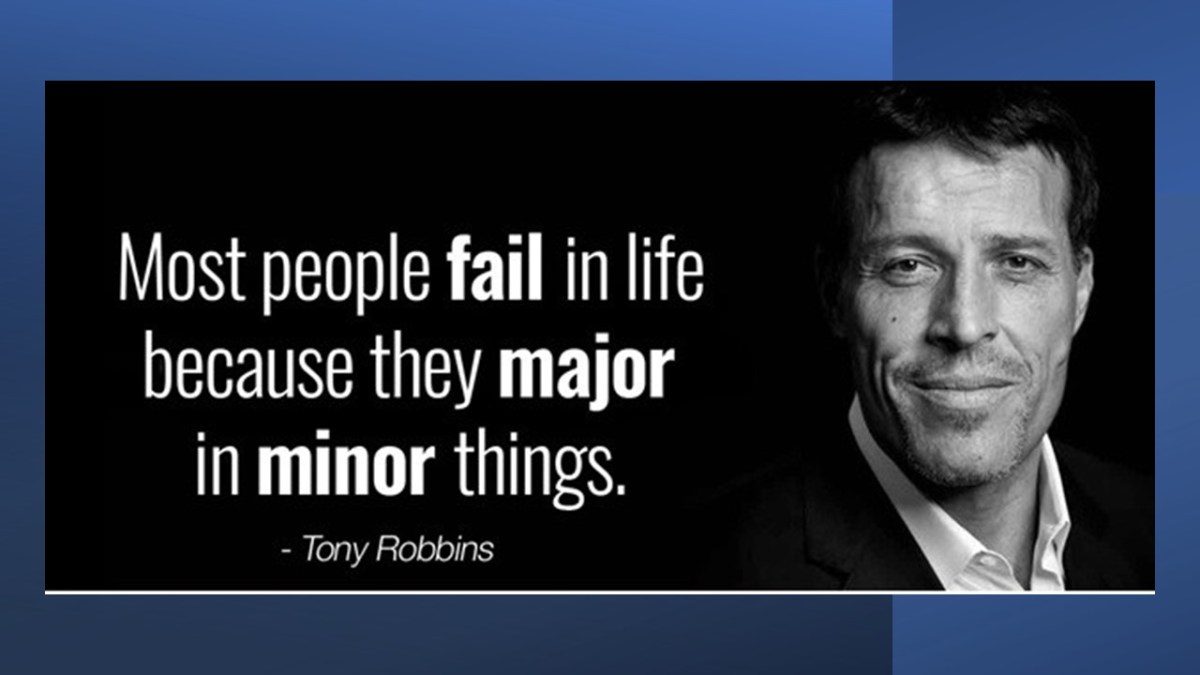
Quit Majoring in Minor Things

Last week I was speaking with several new representatives that have just come into our industry and we were discussing how to become more productive on a consistent basis. I begin to express the importance of investing your time properly. The truth is most people spend much of their day majoring in minor things.

The bottom line is, they simply waste a big majority of their time on things that are not important.

The successful people in life get 24 hours a day. The same holds true for people that are unsuccessful. They also get 24 hours a day. 

The difference is how they spend those 24 hours. 

This is why it’s important to take inventory of your daily activities. You will be amazed how much time is wasted on minor things.

I believe the goal should be for everyone to live a healthy and happy life. I have found that there are three types of people;

– those who make things happen, 

– those who watch things happen 

– those who simply just do not care. 

To achieve in life, you have to make yourself valuable. It’s important to stop wasting time.

In life, there are matters that are of great importance and then there are others that are simply not. 

It is the important things that are the majors in life that are going to require your attention and your efforts. The minor things are just distractions. These are the things that get in the way of your success. The key is to let go of the minors and begin focusing on what your priorities are. 

When it comes to achieving success, you must have a clear goal and a vision. It’s important to set a success plan and be 100% focused on achieving your goals and your dreams. Successful people look at the big picture along with the vision and the strategy of getting to their goals.  It’s important to understand that on the road to success, challenges and obstacles will definitely come. You cannot allow that to bog you down. I’ve seen far too many people do this and it stops them dead in their tracks. This is called majoring in the minor things. I’m not saying they are not important. However, when challenges do come, take a deep breath and analyze the situation. Find the right people that will help you accomplish what is needed to overcome this. You have a big vision and you must keep moving towards that dream. By doing this, it will free you up to focus on what truly matters in the long run.  Far too many people also major in minor things spending too much time preparing. I’ve seen way too many people spending weeks making sure they have the best business cards, flyers and marketing materials. All these are important but what’s more important is getting out there and making it happen. It’s all about priorities. The question is “ Are you busy or are you productive?“ 
It’s time to make a commitment to separate the majors and minors. Many people are not successful simply because they are majoring in minor things.
Starting today, identify what is important and what your priorities are. Once you’ve determined them, you can be confident in what is the correct plan of action. Success takes personal discipline, action and consistency. 

Focus on building your strengths and work on improving your weaknesses. Do not waste time anymore on unproductive activities. Learn to make every second count and make a commitment to eliminate the things in your life that are just distractions.

It is time to make your success a priority and it’s time to do the things on a consistent basis that are going to help you achieve your dreams. Repeat after me, “I no longer have a major in minor things.“

Your future looks amazing. Make every second count and start focusing on what’s important. You can do this!

Happy Selling

David

Spring is in the Air – Grow Your Credit Card Processing Service

Depending on what part of the country you live in, you’ve probably seen tell tale signs that spring has arrived. I for one was anxious for spring to arrive, as it historically marks the start of one of the best times to sell credit card processing services.

Granted the official start of spring started a few weeks back, but as we jump right into the middle of April, I’m curious to know what steps you’re taking to help promote your credit card processing service.

Now,  it’s time to review your sales plan to make sure your profits will grow as fast as everything else around you this season.

The old saying of “the early bird gets the worm” really does apply here. That’s why I’d like to ask you to take the time to honestly answer the following questions.
1. Is your toolbox up to date?

First start by taking a look inside your toolbox. Do you have all of the general tools you need to sell credit card processing? If so, are your tools up to date?

2. Do you have the newer tools you need to be competitive in your market?

Even if you provide the best merchant service, it’s critical that you make sure that you have the new tools you need to be competitive, like  next day funding or touch screen point of sales.

Now mind you the key word here is “need,” not “want.” There are a lot of new “cool” offerings, but time is going to be precious over the next few months. Make sure that there is a need before committing the time to obtain the tools and skills necessary to sell any new offerings.

Here are few I would like you to add to your tool box

1. Clientvine CRM –  If you’re like many merchant services salespeople I know, chances are it’s been a while since you updated or even used a CRM. Dive in as there’s a good chance it needs some tweaks, or perhaps even a complete overhaul.

Let me share an incredible CRM called ClientVine. It’s a full featured CRM that has a huge plus,  It can  do a statement analysis! The good folks at ClientVine will upload our schedule A’s so the system knows our pricing parameters. 

Once again, for more information on ClientVine please feel free to call or email me.  

2. Cash Bouy- Is a merchant cash advance company that has been around since 2002. Cash Bouy has been in the business of helping small businesses. We all know that getting working capital can be challenging for some of our merchnts so at Cash Bouy, they make business funding simple.

3. Are you taking full advantage of what your payment processor has to offer?     Touch Screen POS

You need a good point of sale offering. Rather it’s Clover, Lavu, find a system that can meet your needs. For example, consider the  merchant services software that is available from your current payment processor. Does it offer any unique advantages that you could be leveraging any more effectively then with a POS?

4. How comfortable are you with available pricing options?

In one of my past  blog posts, I spent some time talking about the benefits of tiered pricing and why you shouldn’t cast it aside simply because Interchange Plus appears to be easier. If you’re not sure when to use each method, follow this simple rule.  Under $10,000.00 in volume it would be best on tiered, over $10,000.00 a month put on IC+. This will work well most of the time. 

5. Are you offering a Dual Pricing option?

If your not offering you prospects a dual pricing option your doing yourself and them a disservice. This is an opportunity to save the thousands of dollars and also to make increased residuals for yourself. Find a processing partner that offers a compliant program on terminals, point of sales system, mobile, gateways etc.

In order to be successful selling credit card processing, it’s critical that you perform this exercise before one of the best selling seasons has come and gone.

I’m curious to know your answers to these questions. 

Did you find any areas of concern? 

What steps do you plan to take so you can maximize the growth of your credit card processing service?

Happy Selling,

David

Top 10 Way’s to Build a Sales Pipeline

Keeping your pipeline stuffed is a sure path toward frustration.

Build your sales pipeline in a way that deals flow through with ease from top to bottom.

How? I’ve got this week’s Top10 tips for how to build a healthy sales pipeline.

In true David letterman fashion, from the home office in 

BANZAI PIPELINE HAWAII

 Here are the Top 10 Ways to Build a Sales Pipeline.

10. Know your solution. 

Know how you (your product, your service) help people. If you don’t know your solution, then why are you putting together a sales pipeline? 

9. Know your ICP, Ideal Customer Profile. 

Knowing your perfect customer upfront is absolutely key. This is going to help you determine what goes into your pipeline.

8. Know how to bring value. 

What are the questions that you need to be asking? 

Are there studies that you share that customers normally like, (or whatever it might be)? 

How does this value turn into outcomes that customers get after they buy from you? 

7. Build your cadence.

You can begin to build your cadence based on the answers to the questions above.  

How many times do I have to send them emails,  mail, or a text to turn them into a customer? I need a cadence that I can administer multiple times to many, many people at the same time. So, as you build out your cadence, don’t build it so complicated that you can only handle one prospect at a time. That’s not a cadence. 

6. Create your questions and talking points. 

We spend so much time developing the information we want to share and not enough time spent on the questions we ask. In my cadence,  my messages,  my conversations, in everything I communicate, what are the questions I’m going to ask? What are my talking points? 

My absolute objective is to be able to have this platform of information that I’m so comfortable asking and talking about at any time with any prospect that it becomes a routine. 

5. Establish a routine.

I can establish a routine that I can repeat over, and over, and over again. If you don’t have a routine, it’s just not going to work because there are too many activities involved to be successful.

Organization of a routine brings a method to madness.

4. Leverage your CRM. 

Don’t think you can get by without a CRM. Of course, you don’t have to have a complex CRM. The top of the food chain is Salesforce and Dynamics, for instance. If you’re a small business, you really don’t need those. You can get by with Clientvine, or any number of more simple CRMs.

3. Know your CTAs, call to actions. 

As you’re asking questions, or going through your cadence, what are your call to actions going to be? You need to make sure that you have one for each message you send out.

2. Build your schedule. 

This builds off of your ever-important routine.

What’s your schedule going to look like Monday through Friday? I realize no two days are ever alike, but you’ve still got to have routines.

Routines ensure you follow up enough times with these prospects as you work to understand who stays in your pipeline and who comes out. (You have to be willing to take things out of your pipeline just as much as you are putting things in.)

And the #1 way to build a sales pipeline is…..

1. Execute the plan. 

This means continuously reviewing your pipeline because you don’t want a sewer pipe. A sewer pipeline is where I have all these names and all this stuff in there, and I just don’t know what to do with them. I want to have a water tap that I’m putting prospects in. The questions I can ask have been prepared and practiced. I know the solution I can help them with. They fit my ICP. I know how I can bring value, and I can move them through quickly. That’s executing. 

Have a happy weekend,

David 

“Go for No” in Merchant Services

“You don’t know your going to get a NO until you ask, and if you don’t ask,You’ve given yourself the NO” – Jack Canfield

 One of the first words we learn is “NO.” 

Every toddler learns this important word early in life, normally right after “Mommy” and “Daddy,” Along with learning it early, it quickly becomes a child’s favorite word, as any parent will tell you.

When you sell merchant services, “no” is unfortunately a word that we hear far too often. It is an accepted part of sales, which is why you often hear that you have to have thick skin if you want to be successful.

In fact, most sales people understands that “no” is much better than “maybe.” After all, once you’ve been told “no,” you can move on to a potential “yes.” But the question remains, when is a “no” truly a “no” versus a “not now or later?”

A “not now” is still a potential merchant, but due to certain circumstances he can’t sign today. This doesn’t mean he won’t sign down the road, and is still an opportunity that must be managed correctly.

Before placing a merchant into the “not now” category, answer these 3 questions:

  1. Did I identify a reason other than cost savings to entice the merchant to change?
  2. Did the merchant have a system/terminal or any other hardware that would prevent him from signing?
  3. Is the merchant a fit for my portfolio, and conversely, am I a fit for him?

These questions will help you determine if you should or how often to contact the merchant in the future. For example, let’s say you found a merchant that is experiencing lack-luster service with his current processor. Granted he is experiencing a pain, but it is not great enough to cause him to move just yet. Chances are this issue will compound itself over time, so this makes him a perfect “not now” candidate.

*Remember, if the merchant is using a proprietary such as a POS or other software, he is a “no” unless he is willing to change his system.

Lastly, there must be a good fit between the merchant and your mix of products and services. This fit will increase the likelihood of a long-term, mutually satisfying relationship.

If the merchant has a need and the fit is good, and he is a “not now.” Schedule a repeat visit every 30 days, just to check on him drop off a couple rolls of paper or pens and see how he is doing. Treat it as a courtesy call. Ask the merchant how his business is going and then ask about his pain point and if it’s gotten any better. Let the merchant sell himself, for he will be the first to tell you about his problems related to that particular pain point.

You don’t have to wait the full 30 days though. If you come across a new solution that would be a great fit for a merchant, reach out to him right away. Just say that you came across the solution and thought of him.

There is one important thing to notice with this strategy. I didn’t mention “cost savings.” The truth is that if a merchant is willing to switch from one processing company to another simply to save money, he will sign with the next person who walks through his door promising the same thing. If he chooses not to sign on the first call solely because of cost savings, then he is a “no” and a lesson learned. Once you get to the point where the conversation is solely based on cost, your ability to identify pain points and leverage your solutions is gone.

If the merchant is a “no, put them in the later category and schedule follow-up calls 30-60 days out. Just stop in and check in. Eventually some will want the services you provide and price will not be the issue.  Chase those merchants that are still in play and keep the pipeline full.

Remember, a “not now” is still an opportunity, providing you know how to recognize it and plan for the situation and a no is just a yes that hasn’t happened yet.

Do you have any tips for identifying merchants that fall into the “no” or “not now” category?

Happy selling,

David