STOP SELLING & START HELPING

Being in direct sales for many years now I’ve seen many people come into this field with the wrong philosophy. 

They tend to think that because they have “the gift of gab“, they can sell anything to anyone.   This happens all too often because the focus is on themselves rather than the needs of their prospect.

Unfortunately, they fail because they talk too much and they end up talking the prospect right out of the sale. 

Here is what I have found- The best sales people are the best listeners. 

It’s important to find out what your prospect’s pain points are and then come up with a solution. What you’re selling isn’t a product. It is a solution.  You must learn to develop a rapport with your prospect rather than just pitching them. People don’t want to be sold. They want to be helped. In order to develop a rapport, you must get people to LIKE you. The way you do that is to be sincere, genuine and positive. Most importantly, don’t make it about you, always make it about them.  Learn to get your prospects to talk about themselves. Ask questions and then just simply listen. Show a genuine interest in what they are talking about. Always approach them on their level. Learn to connect with them.

The keyword when it comes to successful selling is HELP. 

If you change your philosophy from selling to helping, you will start having consistent success. Let’s break this word down…


     H onest     E mpathetic     L isten     P roblem solver

There are far too many shady sales people that have given the sales profession a bad name. If you want to be successful long-term, you have to sell with integrity. Rise up and dare to be different. Always be honest. Your reputation and your character are important.  

Having empathy is very important. Learn to care about your prospects. Listen to their pain points and show concern. Most importantly, offer them a solution that is going to help them. Quit over selling and start listening to your prospects. The only way you are going to be able to come up with a solution for them is to find out exactly what their needs are. Listen and then help. Become a problem solver rather than a typical sales person. The typical sales person doesn’t listen and they just keep pitching. 

A problem solver is looking to find the best solution for the prospect’s problems.

The amazing thing is that you will find that these philosophies will help you in your own personal relationships. It’s all about communication.
Make a commitment this week to stop selling and start helping. You will find that your responses will be much more positive and you will have much more success.

Happy Selling,

David

Three Powerful Words in Sales

I was speaking to a salesperson the other day and was asked if there are any specific power words to use in selling. After some though I came up with this.

I have found that there are three words that — when used properly — carry tremendous influence, no matter what the situation, regardless of the type of person you are meeting with. They are:

1. Because

This is probably the most powerful word you can use. From an early age, we have been programmed to accept this triggering word “because”. Remember when you asked your parents why you couldn’t do a certain thing and they responded “because I said so.” Not the best answer, but we learn to accept it. The same is true as adults.

There has been direct research demonstrating this word alone is powerful enough to cause people to allow you an appointment, maintain your price and successfully negotiate. One study showed that people were willing to allow others to cut in line in front of them to make copies with the statement “I need to cut in line because I need to make some copies.”

2. Recommend

This word is great for presenting your solution, but it can be used in many different areas depending on the situation.

In my own sales consultations I often say, “based on what you told me, I recommend…” or “I recommend we set up a time next week to review our solution.”

Whatever the situation, the word recommend positions you properly and allows you to be viewed as an expert endorsing valuable solutions, as opposed to just a product-pushing salesperson.

3. Instantly

When applied conservatively and accurately, the word instantly is excellent to use in your sales letters, marketing collateral, during a presentation or any other area that is appropriate.

The reason it works is because we live in a society which, to some extent, has conditioned many people to expect immediate results. We have microwaves, fast food, video-on-demand, drive thru oil change facilities, and up until recently, easy credit.

We all expect instant gratification instead of waiting for long-term results or gain. Prospects and customers want to solve their problems instantly.

I think we must always pay attention to the words we use and seek to understand why certain words work or do not work in the context of our day-to-day selling. I sincerely believe these words will help any salesperson sell more.

What words are important in your sales pitch?

Happy Selling,

David

Your Future Self Will Thank You For What You Start Today

But you must start off the right way.

A year from now you will wish you had started today.” — Karen Lamb

What have you been dreaming of starting?

What have you been putting off?

What idea have you been eager to make a reality?

What action have you known in your gut you want to take?

Now let me ask:what are you waiting for?

Sometimes it’s good to wait, such as when you’re waiting for the extra money from your tax returns to invest in something promising instead of digging into your emergency fund or worse, debt.

But most things are put off to their detriment. Too often we wait for a time, a circumstance, a moment that may never come, when we really should be making life happen every single day.

“I had as many doubts as anyone else. Standing on the starting line, we’re all cowards.” ―Alberto Salazar

Starting today, starting now, is one of the best things we can do for our dreams, for it makes us get over that fear of starting in the first place!

Start writing. Start reading. Start studying that subject. Start making those calls. Start reaching out. Start asking. Start those exercises. Start that blog. Just start — because nothing else matters if you don’t!

But there’s also the matter of starting properly — another pitfall many trip themselves up in.

In a world that’s obsessed with instant fame, instant success, instant money, instant everything, it’s become harder to start something new without either feeling like a failure right off the bat or never getting into the flow because of unrealistic expectations.

Unrealistic is not a word I like to use often, since what most people think is realistic is the same old boring, mediocre life, but at the same time, starting something new — investing in your dream, yourself, a skill — and then expecting to be a quick guru like so and so or to expect things to be effortless because that’s what X or Y person on YouTube did, is an excellent way to start something you’ll never follow through and never finish.

That sort of perfectionism is a sure-shot way to fail.

Have you ever gone to the gym and felt disheartened when you saw how fit and robust some other people were?

Have you ever tried something new and felt embarrassed when you messed up?

Have you ever faced rejection while pursuing your dreams?

I have. Yes, yes, and yes. I bet you have too to some of these, at some point.

We have to think beyond this! We have to press beyond this! Call it a barrier to entry. Call it a challenge. Starting is one part, and then starting in a way that doesn’t burn us out, but rather plants the seeds of consistency, is the other.

How do we do the latter?

  • Part of this is getting over comparison. Yes, that means starting that blog no matter how it compares to Mashable.
  • Part of this is getting over the pervasive “get rich quick” and “young money” fetish society has. That means not losing hope when you’re not showing off Lambos on Instagram at X age or Y stage in your life.
  • Part of it is getting over your own expectations. Yes, it’s good to have those, but don’t be so rigid that if you don’t meet them you eviscerate yourself. No! Expectations, as John Gorman wrote, can be a sort of hell. Instead, when you fall short, know you’re growing. That’s all that matters. That you’re getting better.

“My attitude has always been, if you fall flat on your face, at least you’re moving forward. All you have to do is get back up and try again.”

— Richard Branson

This is a simple article, it’s a simple idea, but frankly success is simple — it’s just not easy to follow through on.

Embrace imperfection. Embrace falling short. Embrace the inherent ups and downs of the journey. Stop being a victim of your high expectations. What you start now, however small, however imperfect, however much is doesn’t measure up someone else, just might become something massive in the years to come — but only if you start, and only if you start in a way that keeps you going.

In the end, your future self will thank you for what you start today, instead of leaving it for him or her to start a month, a year, or a decade from now.

Invest in yourself.

Invest in your future.

Invest in your capacity to have an impact.

Invest in your own potential to create something beautiful.

Part of the key to success is just starting — action trumps everything.

Another part is in starting properly — so that you keep going.

Your life is yours to mold, an opportunity that encompasses all other potentialities. It can be ridiculously awesome, and you can make that happen, starting right now.

Happy Selling,

David

Friday’s Top 10 Things You Didn’t Know About Cinco De Mayo

Feliz Cinco de Mayo todas! Today is  (translated- Happy Cinco de Mayo everyone)

With today being Cinco de Mayo I thought we’d have today’s Top 10 shed some light on this festive holiday.

While it’s been widely celebrated throughout the United States as a way to honor the heritage and ancestry of Latino communities and culture, it’s also one of the most misunderstood holidays on the calendar.

In fact, the style and substance of the celebration has been sharply criticized for using the culture and history to commercialize and almost cloud the holiday’s true origins. Get the real story with today’s Top 10 Things You Didn’t Know About Cinco De Mayo.

in true David Letterman fashion, From the home office in Puebla Mexico,

here are the Top 10 Things You Didn’t Know About Cinco De Mayo

10. It’s not a big holiday in Mexico

Cinco de Mayo might have deep roots in Mexico’s history, but it’s actually not as big of a celebration as it is in the United States. The holiday is still recognized in parts of the country, but it’s really just another day for its residents and not an excuse to eat, drink and be merry. In fact, the biggest celebrations in Mexico are relatively limited to the country’s capital Mexico City and the town of Puebla that stands as the foundation for the holiday.

9. Cinco de Mayo isn’t Mexico’s Independence Day
It’s also been mistakenly said that Cinco de Mayo is Mexico’s Fourth of July. Even though it recognizes an important victory in the country’s strive for freedom, it is not the traditional day of independence for Mexico. That honor is called ‘El Grito de la Independencia’ and it’s normally celebrated on Sept. 16th. The holiday remembers the beginning of Mexico’s War of Independence in 1810 against the Spanish colonial government.

8. Cinco de Mayo commemorates the Battle of Puebla
The May 5th that the holidays name come from refers back to 1862 as Mexico tried to defend itself from an invasion by the French at the order of Napoleon who hoped to take over the region to expand European free trade and mine the nation’s silver deposits. The Battle of Puebla marked a decisive victory against the occupying army. French forces attempted to take Puebla but they underestimated the local army led by General Ignacio Seguin Zaragoza who were able to soundly defeat them, striking an embarrassing blow to the French invasion.

7. The French retook Puebla the following Spring

Unfortunately, Mexico’s victory in Puebla did not deter the French army from ending their invasion. The following spring, they returned to Puebla and decimated the town, forcing their general to issue a surrender leading to the capture of 17,000 troops and officers.

6. Mexico’s win in Puebla could have changed the American Civil War
One of the reasons that Americans in general celebrate Cinco de Mayo whether they realize it or not is because the Battle of Puebla actually served as a key choke point that, if lost, could have offered a great deal of aid to the Confederate armies fighting the Union in the American Civil War. Another part of Napoleon’s reasons for taking over Mexico was so he could provide aid to the Confederate Army and expand his empire across Mexico and into the US. Puebla victory delayed those plans.

5.Mexico wouldn’t gain their independence for five more years
The Battle of Puebla may have been a decisive victory for Mexico, but the French only lost the battle. The French eventually won the region after a bloody insurrection. French troops finally marched on Mexico City shortly after capturing Puebla and Austrian archduke Ferdinand Maximilian Joseph and his wife Belgian Princess Charlotte were installed as Mexico’s emperors. President Benito Juarez, who refused to surrender when the French overtook Mexico City, led the overthrow of Maximilian and had him executed by firing squad in 1867.

4. The holiday’s original intention was to reach out to communities and culture

Even though historians have been able to trace some of the holiday’s earliest celebrations of Cinco de Mayo to just before the turn of the century, it began to gain steam around the 1950s and 60s. President Franklin D.Roosevelt’s “Good Neighbor Policy” was enacted to improve relations and communication with Latin American countries and communities. Under this policy, Cinco de Mayo was eventually recognized as a national holiday.

3.Its commercialization goes back farther than you think

Of course, by the time the holiday reached into the ’70s and ’80s, corporations co-opted the holiday as a hook to sell lots of alcohol for Cinco de Mayo parties. But that wasn’t the first time a Cinco de Mayo celebration was used to sell stuff. Some of the earliest celebrants in the late 1940s in Corona, CA, found themselves short on funds for the annual fiesta. So the Chamber of Commerce picked up a sponsor that wanted to steer the celebration away from the traditional Cinco de Mayo festival and towards a “Lemon Fiesta” theme to help people recognize “the importance of the lemon industry.” Mexican American leaders expressed vocal opposition to the new sponsored celebration but eventually gave in.

2. It is celebrated outside the US and Mexico with one notable exception
Thanks to the pop culture spread of the not-so-traditional Cinco de Mayo holiday, other countries have picked it up mostly as a way to get people to the bars for a few bottles of Dos Equis and celebrate with the most interesting man in the world. Countries such as Canada, Malta, Australia and the Cayman Islands have their own small Cinco de Mayo celebrations. Vancouver offers one of the more unique celebrations with an annual Cinco de May “skydiving boogie” that offers aerial acrobatics and an air show. Interestingly, Spain does not celebrate Cinco de Mayo. Instead, they celebrate Dos de Mayo (on May 2nd, for you non-Spanish majors out there) to commemorate another key defeat against French forces in 1808.

and the # 1  Things You Didn’t Know About Cinco De Mayo. 

1. The margarita wasn’t invented until well after the first Cinco de Mayo

 OK, I don’t want to be a buzzkill. So don’t let any of this stop you from responsibly enjoying a margarita or two on May 5th at a neighbor’s backyard party. However,

Even this alcoholic staple isn’t technically a Cinco de Mayo tradition. The origin story of the margarita depends on who is telling it, but all of the stories date far after the Battle of Puebla. The earliest version dates back to 1938 in Tijuana where local restauranteur Carlos “Danny” Herrera dreamed up the drink for an aspiring actress who was allergic to every spirit in the bar except tequila but didn’t want to drink it straight.

Others claim that socialite Margarita Sames of Dallas, TX, made the first margarita during a vacation with friends in Acapulco. One of her friends, Tommy Hilton, liked it so much that he put the drink on the bar menu in his hotels. Some dispute this story as an urban legend since three years earlier, Jose Cuervo importer Anthony Dias Blue marketed the drink with the tagline “Margarita: it’s more than a girl’s name.” So you likely have multiple people to thank for your hangover on May 6th.

So there you have it, the Top 10 Things You Didn’t Know About Cinco De Mayo.

Now go close some deals eat some tasty tacos and drink some Margarita’s!

Have a festive weekend,

David

May The 4th Be With You!

Since it perfectly combines mystery, science fiction, action, adventure and drama, Star Wars is still an unquestionable phenomenon of pop culture.

That’s why today being May 4th fans from all around the globe take over the internet to express their love for the galaxy far, far away. And it comes as no surprise that the popular pun ‘May the 4th be with you’ which plays with the franchise’s famous phrase ‘May the force be with you’ is no doubt one of the most tweeted hashtags right now.

Amid the fascinating creatures and lightsaber duels taking place throughout the Galaxy, the story has always relied on philosophical quotes, lessons and sayings to cement its popularity over the years.

So today I picked out the best tips we can learn from the movies that sales force can apply to better their day-to-day working lives.

These are 5 sales lessons that we can learn from Star Wars:

Believe in yourself

“You fail because you don’t believe.” – Yoda

The Grand Master of the Jedi, Yoda, teaches that in order to achieve an objective you must first believe in yourself. As a field sales rep, this is certainly something to keep in mind especially when faced with purchase objections from both clients and leads. Have faith in the product or service you’re selling and your ability to deliver a water-tight pitch and you’ll overcome the majority of these obstacles with ease; if not, you could always try this:

Size does not matter

“Size matters not. Look at me. Judge me by my size, do you?” – Yoda

Throughout his training with Yoda, Luke learns a very valuable lesson about the Force: that size, does not matter (Yoda is what, 5ft tall at most?) However, too often field sales people obsess about the size of the competition, the size of the business and how inferior their product or service must therefore be in comparison.

As Qui-Gon Jinn rightly said, unless you are Salesforce: ‘There’s always a bigger fish’. So, don’t waste your time comparing the size of your business with the size of competing enterprises. Focus on what your company can add and contribute, in what area does it differentiate from the rest and put matters to work to make it happen. We understand that Salesforce is the largest CRM company in the world, but despite that their mobile CRM capabilities and user uptake falls well short of what we have to offer. Size does not matter!

Be patient 

“Patience you must have, my young padawan” – Yoda

One of the most applicable lessons from our wise old Jedi Master brought to us in Revenge Of The Sith. Just as Skywalker had to be patient with the Force, so must field sales reps when it comes to closing those difficult deals. If at first the tactics your initial approach isn’t working, remember that 80% of sales close after the fifth follow-up call. Don’t give up so fast.

It’s also something sales managers could learn from. Most outside sales reps will have gone through a slump, where no matter what lead passed through their pipeline, nothing they seemed to do would lead to a close. Patience, my young sales pro. A little coaching and a closer look at their selling approach might reveal the cause for their drop in form. Take the time to look after your team, and their numbers will in turn take care of you.

Share your knowledge

 “Always pass on what you have learned” – Yoda

This is definitely something seasoned sales professionals can be a little guilty of. Hands up because I certainly know I have. Thinking back to my first time on the road, with our first serious client – bet your bottom dollar I’d have liked a bit of advice before entering the lion’s den.

Sharing the skills and experiences that have helped us grow is invaluable to building a successful field sales team. It’s a good idea to communicate the challenges that you had to face and the methods or tools you used to overcome them because you never know, one day it could be you leading this sales team to success.

Be modest

“Great kid, don’t get cocky.” – Han Solo

From one of the Empire Strikes Back’s most famous scenes, where Luke and Han Solo fight off swarms of TIE fighters in the Millennium Falcon this is a good piece of advice to take with you.

When you close a deal, or reach your sales target, be modest. I know I know, it is important to celebrate and take a moment to enjoy it but nobody likes a show off. Most of us have had to deal with that one person and although you might not be out to win any popularity awards, there’s certainly more respect to be had by helping, not goading the rest of the team. Again, one day you could find yourself up on the that pedestal.

May the 4th be with YOU!

Happy Selling,

David

Why Prospecting Is a War

For many salespeople, prospecting is hard! Some struggle every day to make prospecting happen and unfortunately get hit by far too much friendly fire. 

It’s time to be blunt, I’m on a mission to stop the damaging friendly fire too many salespeople fall victim to.

For those of you who do not understand the term “friendly fire” let me explain. This is where you’re in battle and for one reason or another you’re dealing with an incoming attack that is not from the enemy, but is misguided from your own side. Friendly fire in most cases is preventable, but it takes planning and communication to keep it from occurring. 

Fail to Plan, Plan to Fail.

Similarly in sales, too much prospecting activity serves only to do more harm to the salesperson doing it than good to the prospect it’s directed towards.

When we fail to plan, we shouldn’t complain when our plans fail.  This applies especially to prospecting.  Successful prospecting requires a series of steps to occur in proper sequence and for each step to support the next one. One bad step won’t sabotage your potential success, but it certainly isn’t going to help.  Multiple bad steps and you can call it a day—you’ve inflicted friendly fire upon yourself.

Mistake #1: Word Vomit

It starts with the email, and the desire to include everything ever known to mankind in the email. Stop! Your prospecting email must follow the “one-swipe” rule.  This means the entire email you’re sending a prospect should be readable on a smartphone with only one additional swipe

It’s short; this is not the time to include the wonderful accolades and awards you and your company have received.  The focus is on the prospect and what’s of importance to them today!   Including anything else is setting yourself up for friendly fire.

Mistake #2: TL; DR

This is not the time to leave lengthy messages. If you can’t say what you want, including a call to action in less than sixteen seconds, then don’t leave a message!  I’m not advocating for not leaving a message, but rather for having your act together so you can leave a short message.  

There are two big reasons why your message needs to be short.  First, keeping it short is showing respect for the other person’s time. Do you think anyone wants to converse with someone who is long-winded?  No! Your voicemail is not only communicating a message, but it’s also communicating you and your style. 

Keeping it short also works to your advantage if the prospect’s voicemail system is set up to convert the audio to a text message. 

Go ahead and visualize how long of a text message you’d be leaving if your voicemail was 30-seconds long?  Are you smelling friendly fire?  I sure am!

Mistake #3: A Broken Record

Repeating the same message multiple times, or worse yet, reaching out and not having anything of value to communicate, are fatal. In fact, I would say both of these are so bad that if you’re doing this—save your time and don’t do anything at all.  

Each message MUST be different

Now this doesn’t preclude you from rewording something you’ve already sent. Go for it, reword it, but don’t think you can take one message and reword it five times. Do it once or twice at the most, but then you must change your topic. 

If you can’t come up with at least five to ten different topics to lead with, then you haven’t taken enough time to understand the outcomes you create and how prospects would benefit from them.

Mistake #4: I’m Not a Hotel

The “just checking in” line, whether it be in an email, phone call, voicemail or text—it’s just stupid!  The only time the line “just checking in” works is if you’re at the front desk of a hotel or an airline counter. Use it and you’ll face friendly fire. This all comes back to the need to have different messages you can communicate.  You create value by delivering value.

Happy Selling,

David

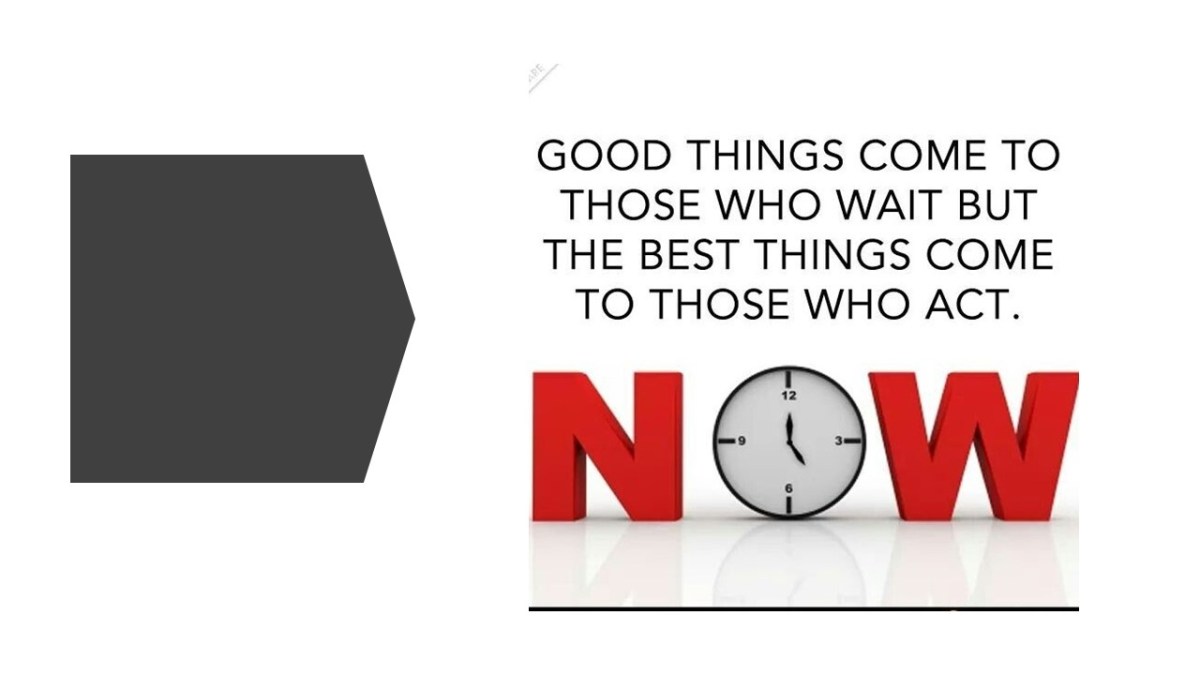
DON’T WAIT – ACT NOW!

We have all seen those commercials on TV for products that are supposed to change your life. They offer an extra incentive if you Act Now.

They are creating urgency for you not to procrastinate because if you don’t do it now, it’s more likely that you will never do it at all.

When it comes to achieving goals, the best time to start is right now! Whatever your goals are, if you are truly serious about them, you must take the first step immediately.

In today’s world, we live in a fast pace environment in which we have a drive-through mentality. We want it, and we want it right now. Whether the goal is to get fit, be super successful in business or learn a foreign language, the final result seems distant and big. Immediately, our brain goes into procrastination mode. Many people will deal with something that’s unimportant first and then, when everything is out of the way, they will go for that goal.

The problem is, they never get to it. Procrastination is the killer of dreams.

  Whatever your goals are, it’s important to make the decision to act on them immediately. Goals are important but you need to have a deep-seated WHY you are doing what you are doing. It must be a burning desire and determination. Your attitude should be. “I’m doing this, no matter what! Nothing is going to stop me or get in my way.” When you write out your goals, also write out the benefits that you will receive once you achieve them. This will give you the motivation to go out and make it happen. Break that big goal into small enough tasks so that you can do them even when you don’t feel motivated.

Now repeat after me “No more procrastination, I am acting on this right now, right here, right where I am.”  

Make the decision to get rid of all the excuses like “I’m not ready, I need more training, I don’t know what I’m doing yet.” Whether you feel you are ready or not, it does not matter. The only way that you are going to excel at something and achieve your goals is to get out there and do it right now. Figure out the first step and just do it. You may need to make the first step you take a small one, that’s OK. Make the step as small as you need it to be to ensure that you will do it. Write down the thing that you will do right now and simply do it.

I’ve heard many people say “If you believe it, you can achieve it.” That may be true, but it’s not enough. ACTION is the foundational key to success. By acting right now, you will start to build momentum. Once you’ve taken that first step, make sure you know what the next step is and make a decision to take it. Keep moving and keep marching forward. If you want success, you have to take massive, determined actions.

Success is going to take a big commitment. You must commit to action every single day. You have to be relentless. By doing this, the actions that you take will become a routine habit. When you have a habit, you don’t even think about it anymore. This is part of your life. This is something that you do daily.

 The extra effort will also bring you to an even higher level. The difference between mediocrity and success is an extra 10% effort. Whatever it might be, when you’re close to finishing or you’re feeling tired, put 10% more into it. Keep stretching yourself and you will grow.

Your goals and dreams can come true. It’s entirely up to you. No more procrastinating! You have incredible opportunities in front of you. They are life-changing and you can live the life of your dreams. There are no secret formulas. All you have to do is want it badly and then make the decision to go out and get it. Incredible opportunities are waiting. ACT NOW!

Happy Selling,

David

Raising Your Standards

If you want to improve your life, you simply have to raise your standards. We all have things in our lives that we know we should follow through with. Every year, New Year’s resolutions are made and we know what we should do but, in most cases, we don’t follow through.

The bottom line is if that’s happened to you, you did not raise your standards enough to make it happen.

When it comes to raising standards, it’s all about making it a priority.

Rather than saying we should do something, it’s important to change that into I MUST do something.

When you do that, you are now taking control over the quality of your life. You are now in a position to achieve what you want out of life. It now becomes a priority for you.

If you want to change your life, you simply have to change your standards. It’s all about mindset.

Your thoughts determine your actions. It’s important to be your own cheerleader.

Use the power of self affirmation which will inspire you to become great. By raising your standards, you will not be defeated by the failures or setbacks. You will learn that every obstacle is an opportunity to learn and grow.
When raising your standards and going to the next level, it’s going to take a lot of self discipline. Success is a result of what you do daily. The choices you make each day set the foundation for your standards. Make every second of your life count and do not waste time on things that are not helping you achieve your goals. Do not give into temptations. Your goal is to be successful in every phase of your life. Think of the future. Make the right decisions.

It’s important to take a look at what you’re allowing in your life. Take inventory. Think about what things are positive along with the things that may be hindering you.

It’s time to set the bar higher. It’s time to take positive action and make it happen.

Make positive choices each day. Your standards aren’t going to magically raise themselves. You need to make small changes and develop new positive habits every single day. It all starts with small steps. Make sure you are giving yourself credit for taking them.

Finally, surround yourself with positive influences.

Never underestimate the role the people you spend most of the time with play in your life.

Does your inner circle have higher standards for themselves?

Think carefully about what type of influence other people are having on you.

You may have to distance yourself from them if you truly want to raise your standards. Be open to new friendships with people who are in a similar frame of mind that you are. Look for positive influences everywhere you go.Your standards should match the kind of person you wish to be and the lifestyle that you would like to have. Life is short. You might as well enjoy it at a higher level. Enjoy the journey and be a blessing to every person that you encounter. This is your time to go to the next level.


Rise Above!! and Happy selling,

David

TOP 10 Way’s to Improving Your Selling Skills in Just 30 Days

Today, I’m sharing 10 ways to improve your selling skills in just 30 days. These are practical things you can start doing right now.

In true David Letterman fashion,

from the home office in Terramuggus, Connecticut, here are the Top 10 TOP 10 Ways to Improving Your Selling Skills in Just 30 Days,

10. Discipline


You have to be disciplined in how you use your time and what you spend your effort on. You cannot allow yourself to be caught up in the shiny objects. You have to be disciplined to know exactly what you are going to achieve, and then be actively achieving it. Do not waste your effort; if salespeople would simply be more disciplined in how to use their time, it is amazing how much more successful they would be.

9. Consistency


This means consistency with your prospects. You cannot sit there and call some prospects once, then not call them back for six months or even a year. You have to have a consistent sales process that you are using more than anything. More than anything, I always hear people say, 

“Well, I don’t have a good plan.”

 Me: “Well, what’s your plan?”

 Them: “I don’t have a plan.”

 Well, that’s your problem! I almost say this: It does not matter what your plan is, just be consistent with it. Just be consistent. When you are consistent with your prospecting, it is astonishing how much more disciplined you are – you see how these two things really fit together?

8. Learn From Your Existing Customers


I want you to learn from your existing customers. You see, your existing customers are full of a lot of knowledge.

I want you to learn from them and be reaching out to them, even if your sales process is one where – after you sell a customer – you don’t have any more engagement. I want you to reach back out because you are going to learn from them. They are going to help tell you, show you and guide you.

7. Less is More


It’s not about having 10,000 prospects. It’s not about having 1,000 prospects. It’s really about having fewer prospects that I can spend more time on. Less is more in everything I do. I don’t need 10,000 scripts. I don’t need 10,000 emails sent out. I need four or five because less becomes more. What happens when you adopt this mindset is you become more efficient and more effective in how you use your time.

6. Tight Customer List


Here’s the thing: You do not have time to chase every opportunity out there.

If the opportunity, lead or prospect that you see does not line up with what you believe is going to be potentially profitable to you, then do not. Go. After. It.

Stay tight; I see too many salespeople just start flashing lights when they get into trouble, turning to whatever they can to try to get attention or try to fight. No, stay tight. I would much rather you have 20 prospects you are reaching out to though a consistent process with a very tight message than to be sitting there trying to chase 100, 200, 300 prospects you only reach every couple of months.

Nope, that does not work. Keep a tight customer list.

5. Be Accountable


Be accountable and show up. You have to be accountable to yourself and I want you to be accountable to somebody else. This means, very simply, you need an accountability partner who is going to help hold you accountable for your goals. This means you are sharing with them what your goals are and vice versa.

You know what’s interesting about this? As you coach them, it’s going to help you. A rising tide lifts all boats.

I want you to be accountable now, both to yourself and to your customers. When they say something, you have got to follow up with them. You have to remain engaged with them. Again, I see too many times where salespeople have an opportunity and never call. Them. Back. They never re-engage. I see more salespeople losing business because they failed to follow up on a lead fast enough.

4. Simplify


Do not make it overly complicated. We can screw up a two-car funeral pretty good.

What I want you to do is simplify your message – simplify what it is that you sell because…if it isn’t simple in your mind, how is it going to be simple to your prospects? It’s not.

Too many salespeople get desperate and want to go out and sell every tool in the toolbox. You can’t. I am going to lead with one specific tool, and I am going to zero in on it.

When you simplify, it’s surprising how much faster you’re able to move. Speed comes into play here. Now, of the 10 things I’m discussing with you today, your speed is not one of them. But what I have found is when you make it a point to do the 10 things I am walking through, you will find yourself operating much more efficiently. 

3. Grow Your Mind


You can never allow yourself to stop growing. This means you have to be saying, “How and what am I learning about my industry?”

“How and what am I learning about my customers?”

What are you doing? You have to be continuously growing. You have to take 15 minutes a day – it might be digging into a book or maybe an article pertaining to your industry. No matter what, you have to be continuously and intentionally growing your mind.

What happens? Not only do you gain more knowledge, but you also gain a tremendous amount more confidence. And, when you’re more confident, it’s amazing how much better you listen.

2. Attitude


Nothing fuels your energy more than your attitude.

If you have a bad attitude, you won’t have the energy. If you have a bad attitude, it’s noticeable how it comes across in your phone calls, your emails, on and on. When you have a bad attitude, you don’t listen as much. Your attitude drives a lot more than you would think.

And the #1 Way to Improving Your Selling Skills in Just 30 Days is …

1. Don’t Stop


Do not stop. I see too many salespeople get a little bit into the process and think, “Well, we’re not getting the traction,” and they step away. Everyone has heard the stories of salespeople giving up too early, and that is exactly what happens. If you want to be successful, don’t stop!

If you go through and do the previous nine things that I have been talking about and lastly, do not stop, I guarantee you will be more successful with your selling in 30 days or less.

Have a great weekend,

David 

TOP 5 PAYMENT PROCESSING TRENDS TO FOLLOW

As technology and business trends continue to evolve, so do the needs of business owners and consumers. And let’s face it, the pandemic was a key indicator that keeping up with the Joneses and offering customers multiple payment options is a sound business strategy. It’s essential for businesses of all sizes for the direct impact on revenue, customer satisfaction and being flexible with your customers when it matters most.

Additionally, payment processing trends affect the security and compliance of payment transactions. Therefore, keeping up with payment trends ensures that businesses can provide secure payment options while complying with ever-changing industry standards and regulations.

By adopting the payment processing technology we summarize below, businesses can provide customers with a seamless payment experience and give their business the tools it needs to be competitive and boost efficiency.

Top Payment Trends to Follow:

  1. Embedded Payments
  2. Buy Now Pay Later
  3. Subscription-Based Payments
  4. Real-time Payments
  5. Dual Pricing and Surcharging

Trend 1: Embedded Payments

Embedded payments, also known as integrated payments, have taken the payments industry by storm, and for good reason. So, what exactly are embedded payments and how do they work?

At their core, embedded payments are payment processing solutions that are integrated directly into a SaaS platform’s software, application, or website. This means that customers using the software can complete a payment without ever leaving the product or service they are using. Keeping it simple, think of a time when you ordered a pizza through a food delivery app like GrubHub. The payment process is embedded within the app itself, streamlining your experience rather than being redirected to a separate payment platform.

Another way to think about this is when you hand your card to the cashier in an automotive repair shop that uses software to manage appointments and provide estimates in the shop or via email. With embedded payments, shop owners can manage all aspects of their business and collect payments at the time of service or with features like text-to-pay all within the software. Even better, embedded payments help businesses say goodbye to reconciling nightmares and double entry as transactions are reported within the software.

The benefits are clear. Embedded payments can enhance the customer experience by providing a seamless and secure payment process within the software solution. This can help build customer trust and loyalty. Additionally, embedded payments can simplify payment processing, reduce errors and operational costs, and improve cash flow by helping customers get paid faster. Overall, embedded payments help businesses boost efficiency and revenue while enhancing the customer experience.

Trend 2: Buy Now Pay Later (BNPL)

Buy Now Pay Later (BNPL) is a payment option that allows consumers to make purchases and defer payment until a later date. BNPL providers offer customers an interest-free loan to make purchases, with the option to pay the balance off in installments over a set period of time. Customers can typically choose the number and frequency of installments that work for them, which can help make larger purchases more manageable. 

Next time you are shopping online, take a look before checking out and think about how these options might look in different retail settings.

BNPL providers typically partner with retailers to offer their services at the point of sale, making it a convenient option for consumers to make payments on their own terms. This solution has become increasingly popular particularly for younger consumers who may prefer to avoid credit cards and traditional loans.

Offering Buy Now Pay Later to your customers can provide a number of advantages for both your business and your customers. By allowing customers to spread out payments over time, you can attract customers who may not have been able to make a purchase otherwise. For businesses, offering BNPL can increase sales and revenue by reducing cart abandonment rates and providing an attractive payment option for customers.

Trend 3: Subscription-based Payments

Subscription-based payments have become increasingly popular in recent years, particularly in the realm of digital services and products. The convenience and predictability of subscription payments make them an attractive option for consumers who want to avoid hefty payments up front or lengthy contracts. 

For businesses, subscription-based payments provide a predictable revenue stream, which can be highly valuable for SaaS companies and other subscription-based businesses. Mainly, it helps businesses reduce the need for costly marketing and customer acquisition efforts by having monthly retainers with existing customers.

The trend towards subscription-based payments has only accelerated in the wake of the pandemic, as more consumers shift to online services and entertainment. As such, businesses that offer subscription-based payment options can take advantage of this growing trend and benefit from a predictable revenue stream and increased customer loyalty.

Trend 4: Real-time Payments (RTP)

Real-time Payments (RTPs) are in line with the expectations of how the world should process payments. No more waiting for deposits to hit or checks to clear. RTPs refer to an electronic payment system that enables immediate and instantaneous transactions between two parties. The most well-known examples of Real-time Payments in the United States are The Clearing House’s RTP network and FedNow, the Federal Reserve’s anticipated real-time solution projected to launch in 2023.

Unlike traditional payment methods that can take several days to complete, real-time payments allow for near-instantaneous transfer of funds. This is made possible by a network that connects banks and other financial institutions, allowing them to communicate and transfer funds in real-time. 

With real-time payments, you can make and receive payments 24/7, 365 days a year, without any delays or interruptions. This makes it a convenient and efficient payment processing option for businesses and individuals.

From a speed perspective, the benefits of RTPs are clear. Payments are sent and received faster than ever before, giving small business owners exactly what they need, immediate cash flow. While speed is a primary benefit, the biggest impact is the reduction in money that’s locked up in the various stages of payment processing. The guarantee that funds clear instantly improves liquidity for small businesses and paints a clear picture of their finances in real-time.  

Real-time payments also reduce the risk of fraud and errors, as funds are transferred within seconds. With a reduced number of transactions that require manual attention, i.e., a failed payment, businesses can also reduce costly, time-consuming reconciliation issues.

Trend 5: Dual Pricing and Surcharging

Dual Pricing and surcharging are two pricing strategies that can help businesses offset the cost of accepting credit cards by sharing processing costs with the end consumer. 

What is Dual Pricing ?

Dual Pricing or cash discount program is a method of offering a discount to customers who pay with cash, while customers paying with credit card pay the advertised rate. The advertised rate has a built in amount to help account for the processing cost. 

What is Surcharging?

Surcharging involves adding a fee to the total purchase price for customers who pay with a credit card, while offering the lower advertised price to those who pay with cash. Surcharging is legal in most states in the U.S., while cash discounting is legal nationwide.

These methods can be used to encourage customers to pay with cash, which can help businesses offset the cost of credit card processing. However, it’s important to note that these methods come with legal and regulatory considerations that should be carefully evaluated before implementing them.

For businesses, these pricing strategies generate real savings and help put money back into the business that can be reinvested elsewhere. This can be especially beneficial for small businesses that operate on tight budgets. 

If you are interested in implementing a cash discount or surcharging program, can support all business types with our industry leading cash discount and surcharging programs.

In conclusion…

Payment processing technology is constantly evolving, and staying on top of the latest trends is crucial for businesses to remain competitive. The top 5 payment processing trends to follow in 2023 and beyond include embedded payments, Buy Now Pay Later, Subscription-based Payments, Real-time Payments, and Dual pricing and Surcharging Programs.

These trends are not only shaping the future of payments but are also transforming the way businesses operate and interact with their customers. As we move forward, it’s important for business owners to embrace these trends and partner with a processing company who can help implement them to enhance customer experiences, increase efficiency, and drive revenue growth.

Let me know what trends your currently offering.

Happy Selling,

David