3 Ways to Grow Your Business

Like any seasoned professional in outside sales, honing a routine that adapts to the unpredictable nature of the job takes time and dedication. While discovering the right approach may require patience, establishing a structured framework for your week can yield significant benefits. This structured approach affords you the time to cultivate leads, engage with new prospects, and explore innovative methods to expand your client base in an organized and efficient manner.

Crafting a Consistent Schedule: In the realm of sales, daily routines can be challenging to maintain due to the ever-changing landscape. Instead, consider devising a weekly plan to provide a broader perspective. This approach allows you to allocate specific days for activities such as scheduling meetings, making calls, visiting clients, and planning for the upcoming week. By segmenting each day and instilling a sense of structure, you can navigate your tasks effectively while retaining flexibility to tackle unforeseen events.

Leverage Client Referrals: If you’ve observed a decline in new business opportunities, revisiting former clients to solicit referrals can prove fruitful. Many business owners participate in local chambers of commerce or similar networks, making them valuable sources for referrals. Cultivating strong relationships with existing clients can facilitate word-of-mouth referrals, thus bolstering your client roster and sustaining residual business.

Harness the Power of Social Media for Lead Generation: In today’s digital age, social media platforms offer invaluable avenues for expanding your professional network and acquiring new leads. Utilize these platforms to showcase your services, reconnect with acquaintances, and engage potential clients. Leveraging platforms like LinkedIn, Facebook, and Twitter enables you to establish meaningful connections and broaden your reach within your industry.

Tailoring Strategies for the Merchant Services Industry: For professionals operating in the merchant services sector, social media serves as a particularly potent tool for forging new connections and nurturing existing relationships. Platforms like LinkedIn provide avenues to connect with prospective clients and expand your network within the industry. By highlighting the benefits of merchant services, such as streamlined pricing structures and enhanced profitability, you can effectively communicate value propositions to potential clients.

Why Sell Merchant Services? Offering merchant services presents clients with a myriad of advantages, including access to innovative pricing models and superior service. By adopting a flat monthly fee structure, businesses of all sizes can reduce overhead costs, bolster profits, enhance employee benefits, and foster growth opportunities. Embracing merchant services not only benefits your clients but also positions you as a trusted advisor capable of delivering tangible business solutions.

Share Your Sales Strategies: What methods have you found most effective in bolstering your sales efforts? Let’s exchange insights and strategies for optimizing sales performance in dynamic environments.

Happy Selling,

David

5 Tips For Introverts In sales

In the world of selling, extroversion is often celebrated as a key trait for success. Surprised? I’m not. This may come as a shock to some of you but I’m somewhat of an introvert myself and I’m here to share 5 tips for us introverts.

Being an introvert doesn’t mean you can’t thrive in sales—in fact, it can be a secret weapon. In this blog, I’ll explore how introverts can leverage their unique strengths to excel in sales and build meaningful connections with customers.

  1. Authenticity and Empathy: One of the greatest strengths of introverts is their ability to listen attentively and empathize with others. Use these qualities to your advantage by genuinely understanding your customers’ needs and concerns. Take the time to listen to their challenges, ask thoughtful questions, and offer tailored solutions. By demonstrating empathy and authenticity, you can build trust and rapport with your customers, laying the foundation for long-term relationships.
  2. Preparation and Research: Introverts often excel in preparation and research, which are essential aspects of successful sales. Leverage your natural inclination for thoroughness by conducting extensive research on your products, industry trends, and customer demographics. Use this knowledge to anticipate questions and objections, allowing you to respond confidently and effectively during sales interactions. By being well-prepared, you can instill confidence in your customers and position yourself as a trusted advisor.
  3. Strategic Networking: This is one I struggle with. While us introverts may prefer one-on-one interactions over large networking events, they can still excel in building meaningful connections. Focus on quality over quantity by strategically selecting networking opportunities that align with your interests and goals. Rather than trying to meet as many people as possible, invest your time in cultivating genuine relationships with key contacts. Remember that meaningful connections can lead to valuable referrals and opportunities for collaboration.
  4. Leveraging Technology: In today’s digital age, introverts can leverage technology to their advantage in sales. Use email, social media, and other online platforms to initiate conversations, share valuable content, and nurture relationships with customers. Virtual communication allows introverts to communicate on their own terms, without the pressure of face-to-face interactions. Embrace technology as a tool to enhance your sales process and reach a wider audience.
  5. Self-Care and Boundaries: It’s important for introverts to prioritize self-care and set boundaries to avoid burnout in the fast-paced world of sales. Schedule regular breaks throughout the day to recharge and decompress. Find activities that replenish your energy, whether it’s reading, exercising, or spending time alone. Establish clear boundaries around your time and commitments, and don’t be afraid to say no when necessary. By taking care of yourself, you’ll be better equipped to perform at your best in sales.

Being an introvert in sales comes with its own set of challenges and opportunities. By embracing your strengths, such as authenticity, empathy, preparation, strategic networking, and leveraging technology, you can succeed in sales while staying true to yourself. Remember that being an introvert is not a limitation—it’s a superpower that can set you apart.

Happy Selling,

David

Planning Your Day

As a salesperson, planning our day is crucial for maximizing productivity, efficiency, and ultimately, success in achieving my sales targets. Here’s how I typically structure my day:

  1. Morning Routine: I start my day early to ensure I’m prepared and energized for the tasks ahead. My morning routine includes exercise, reading, and breakfast to set a positive tone for the day ahead. A clear mind is essential for staying focused and motivated throughout the day.
  2. Review Goals and Priorities: Before diving into any specific tasks, I take a few minutes to review my sales goals for the day, week or month and prioritize my tasks accordingly. This helps me stay aligned with my targets and ensures that I focus on activities that will have the most significant impact on achieving them.
  3. Prospecting: One of the fundamental tasks of a salesperson is prospecting—identifying and reaching out to potential customers who may benefit from our products or services. I dedicate a portion of my morning to prospecting activities, which may include cold calling, sending personalized emails, or connecting with leads on social media platforms like LinkedIn.
  4. Follow-Up and Relationship Building: Building and maintaining relationships with existing clients and prospects is key to long-term success in sales. I allocate time each day to follow up with leads, respond to inquiries, and nurture existing relationships. This may involve sending follow-up emails, making follow-up calls, or scheduling meetings to discuss ongoing projects or new opportunities.
  5. Sales Meetings and Presentations: Depending on my schedule for the day, I may have sales meetings or presentations planned with potential clients. Whether it’s a virtual meeting or an in-person appointment, I ensure that I’m well-prepared by researching the prospect’s business, understanding their needs, and tailoring my presentation to address their specific challenges and objectives.
  6. Administrative Tasks: Sales is not just about selling—it also involves a fair share of administrative tasks, such as updating CRM systems,(Joe, is this about you?) preparing sales reports, and responding to internal emails. I allocate time each day to take care of these administrative duties to ensure that my sales pipeline remains organized and that I have accurate data to inform my sales strategies. My view if it’s not in the CRM it didn’t happen.
  7. Continuous Learning: Sales is a very diverse field that requires constant learning and adaptation to stay ahead of the curve. I dedicate time each day to engage in professional development activities, such as reading industry blogs, listening to sales podcasts, or attending webinars and workshops. This helps me stay informed about the latest trends, techniques, and best practices in sales.
  8. End-of-Day Review and Planning: As the day winds down, I take some time to review my accomplishments, evaluate my progress toward my sales goals, and plan for the next day. I identify any tasks that need to be carried over and prioritize my to-do list for the following day, ensuring a smooth transition and a productive start to the next morning.

By following this structured approach to planning my day as a sales professional, I’m able to stay organized, focused, and proactive in pursuing my sales objectives while also maintaining a healthy work-life balance.

Happy Selling,

David

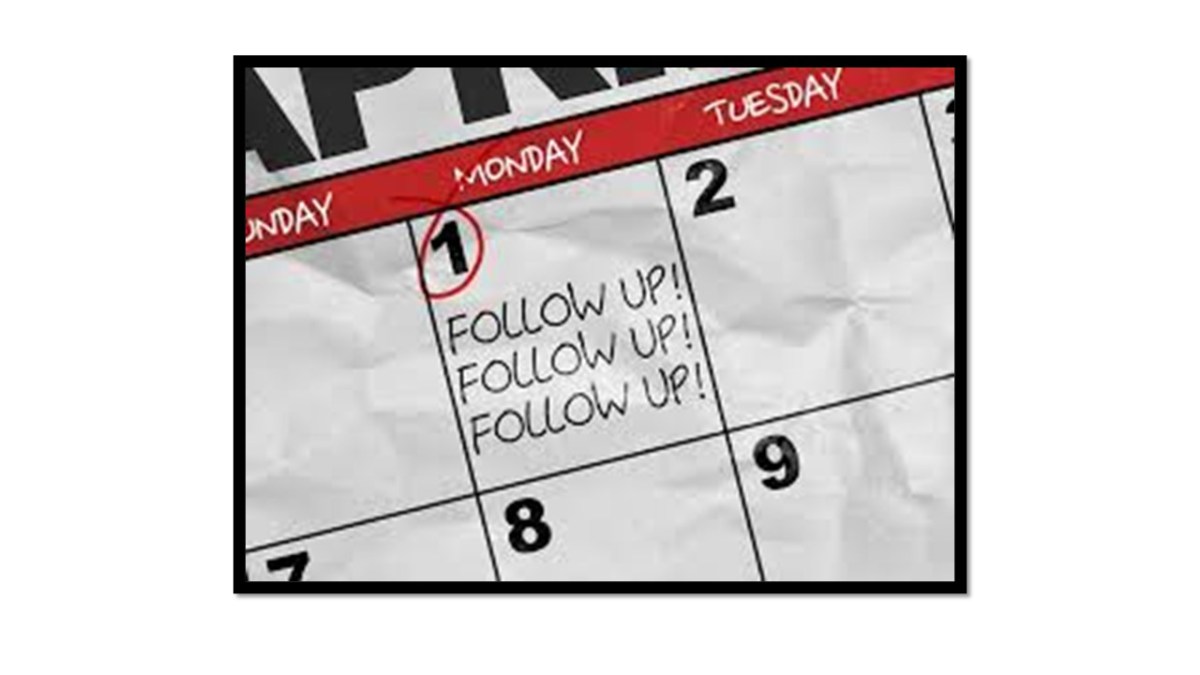
Follow Up Till They Buy or Die

In the world of sales, persistence pays off. While securing a sale may require multiple touchpoints and interactions, the payoff can be substantial. Let’s delve into the importance of persistent follow-up in sales and share a few strategies to help you master the art of perseverance in pursuit of closing the deal.

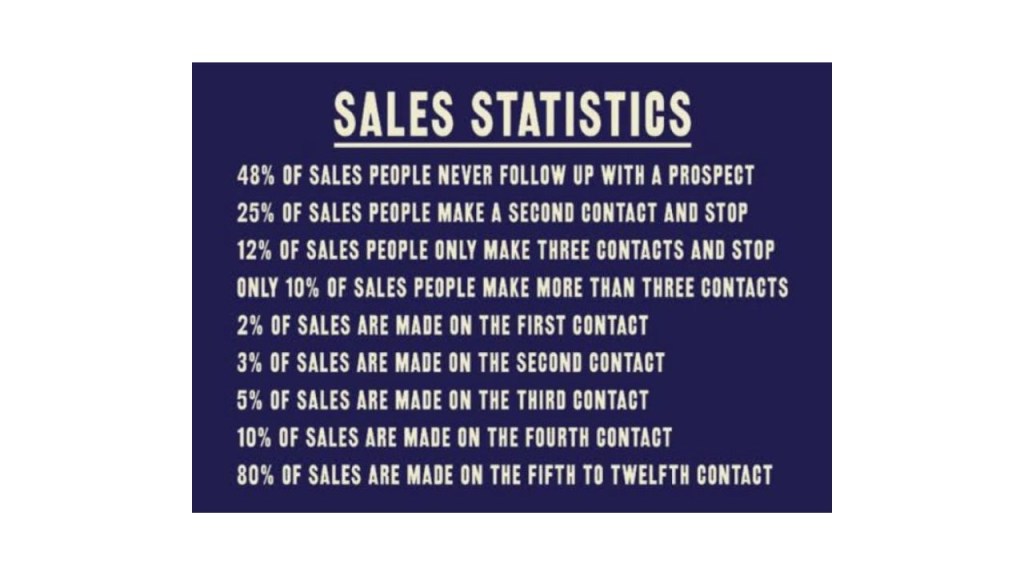
The Power of Persistent Follow-Up: Follow-up is often the difference between a lost opportunity and a closed sale. According to research, it takes an average of five to eight follow-up attempts to convert a prospect into a customer. Yet, many sales professionals give up after just one or two attempts, leaving potential opportunities on the table. By embracing the mantra of “follow up till they buy or die,” you demonstrate your commitment to serving your customers and maximizing your sales potential.

  1. Establish a Follow-Up Schedule: To maintain consistency and accountability in your follow-up efforts, establish a follow-up schedule and stick to it religiously. Whether it’s a weekly email, a bi-weekly phone call, or a monthly check-in, schedule regular touchpoints with your prospects to keep the conversation alive and nurture the relationship. Use a CRM system or calendar reminders to stay organized and ensure no follow-up falls through the cracks.
  2. Personalize Your Approach: Tailor your follow-up messages to each prospect’s preferences, needs, and stage in the buying journey. Reference previous conversations, highlight relevant benefits or solutions, and demonstrate genuine interest in helping them achieve their goals. Personalization shows that you value the prospect as an individual and are invested in their success, increasing the likelihood of a positive response and engagement.
  3. Provide Value with Every Interaction: Make every follow-up interaction valuable and meaningful by offering insights, resources, or assistance that align with the prospect’s interests and challenges. Share relevant articles, case studies, or industry trends that demonstrate your expertise and provide value beyond your products or services. By positioning yourself as a trusted advisor and resource, you strengthen the relationship and differentiate yourself from the competition.
  4. Use Multiple Channels: Experiment with different communication channels to reach your prospects and increase your chances of getting a response. In addition to emails and phone calls, leverage social media, direct mail, or networking events to stay on their radar and stay connected. Mix up your approach based on the prospect’s preferences and behavior, and be persistent in your pursuit across all channels.
  5. Know When to Pivot: While persistence is essential in sales, it’s also important to recognize when it’s time to pivot or adjust your approach. If a prospect consistently ignores your follow-up attempts or expresses disinterest, it may be a sign to reevaluate your strategy or focus your efforts elsewhere. Be mindful of the prospect’s signals and feedback, and be willing to adapt your approach accordingly to maximize your effectiveness.

In the competitive world of merchant services, persistence is the secret sauce that sets top performers apart from the rest. By embracing the mindset of “follow up till they buy or die,” you demonstrate your dedication to serving your customers and achieving your sales goals. By establishing a follow-up schedule, personalizing your approach, providing value, using multiple channels, and knowing when to pivot, you’ll master the art of persistent salesmanship and unlock new opportunities for success. So, keep following up, keep pushing forward, and never underestimate the power of persistence in driving results.

Happy Selling.

David

Why Are YOU in Sales?

Are you committed to making it happen in sales? …Do you even want to be in sales?  Whether or not you got into sales for the right reasons, (I sure didn’t!) it’s not too late to find purpose and satisfaction in what I think is the best profession in the world.

What is the primary reason you’re in sales?

I admit I first got into sales only because of the money and the car. I couldn’t afford car insurance, and I needed a job that supplied me with a car. As a result, I sought out a sales job that supplied me with a company car. That was my motivation for being in sales. 

So between the money and car, I was a happy camper. But you know what’s funny? I got fired from my first two sales jobs. I didn’t know why I was in sales. Or perhaps I did, but it wasn’t the right reason to be in sales. 

What is your motivation for being in sales?

It wasn’t until my third sales job, selling cars that my boss pulled me into his office, sat me down, and really grilled me as to why I was in sales and whether or not I was committed. He could tell that I wasn’t in sales for the right reason.

He said, “Until you focus on the customer; understanding the needs of the customer, what drives the customer, why we’re helping the customer—you’re not going to be successful.”

I still remember that day very well—I was on my way to getting fired from my third sales job! I thank my boss, Valester Perkins, for sitting me down. 

Sales is about the customer. 

Sales is not the commission. It is not all the other thrills and chills that we get out of it. Sales is totally about the customer. Without the customer, we wouldn’t have sales. We wouldn’t have commissions, we wouldn’t have a job. 

And yet I find so many salespeople not paying attention to that, and instead racing forward. They have the initial call and if they’re in tech, they want to race to the demo and they want to try to close. But it never happens, because they didn’t take the time upfront to really understand the customer. Understanding the industry is not enough, that individual customer requires special attention. 

Prospecting the top of the funnel is all about understanding the customer, understanding their needs. If we can’t be committed to that, we’re not going to be successful.

Be thankful for the opportunity to work with customers.

Do you value your customer? 

Each day, I want you to stop and be thankful for the opportunity to work with your customers regardless of where we are in the process, or the quality of customers you might have. Without them, you wouldn’t have a job.

Sales is a people business. Understanding their needs is where it happens.

My decision to pursue a career in sales stems from a combination of personal interest, professional aspirations, and the desire to make a positive impact. Sales allows me to leverage my interpersonal skills, embrace continuous learning, influence others positively, nurture my entrepreneurial spirit, and reap financial rewards—all while doing what I love. It’s not just a job; it’s a fulfilling journey that aligns with my passions and goals, and I couldn’t be happier with my choice.

Happy Selling,

David

Friday’s Top 10 Surprising Facts About Father’s Day

On Sunday, June 16th, dads across the United States will be showered with gifts as they celebrate Father’s Day. Though it’s something we can count on celebrating every time the third Sunday in June rolls around, the holiday didn’t always have the public support it deserved. In fact, for decades it looked as if a day dedicated to the influential and hard-working fathers in our lives would toil in relative obscurity.

Let’s read on to learn about the tragic origins and eventual nationwide acceptance of this beloved holiday.

From the Home Office in Dad, Minnesota Here are this Friday’s Top 10 Surprising Facts About Father’s Day

Here we go,

10. The first modern Father’s Day was rooted in tragedy.

On July 5, 1908—the same year that Mother’s Day is credited as beginning—a small church in West Virginia held the first public event meant to specifically honor the fathers of their community. The day was held in remembrance of the 362 men who were killed the previous December in a mining explosion at the Fairmont Coal Company. Though this specific day did not transform into an annual tradition in the town, it did set a precedent of reserving a day for dads everywhere.

9. Washington was the first state to celebrate Father’s Day.

In 1909, Spokane resident Sonora Smart Dodd was listening to a Mother’s Day sermon at her local church when she had the idea to try and establish a similar day to honor the hard-working fathers of the community. Dodd was the daughter of a widower and Civil War veteran named William Jackson Smart, who raised six children on his own after his wife died during childbirth.

She contacted local church groups, government officials, YMCAs, businesses, and other official entities, hoping to gather the community to recognize fathers around the state of Washington. The campaign Dodd embarked upon would eventually culminate in the first statewide Father’s Day celebration in 1910.

8. That Father’s Day takes place on the third Sunday in June just happened by accident.

While Father’s Day always takes place on the third Sunday of June now, that date was actually a compromise after the original turned out to be unrealistic. Dodd’s goal was for the holiday to be observed on June 5 to land on her father’s birthday, but when the mayor of Spokane and local churches asked for more time to prepare for all the festivities involved, it was moved to the third Sunday in June, where it remains today. Officially, the first Father’s Day celebration took place on June 19, 1910.

7. Roses were originally a big part of the Father’s Day celebration.

The first Father’s Day included a church service where daughters would hand red roses to their fathers during the mass. The roses were also pinned onto the clothing of children to further honor their fathers—red roses for a still-living father and a white rose for the deceased. Dodd also brought roses and gifts to any father in the community who was unable to make it to the service. This gave birth to the now-nearly-forgotten tradition of roses as the customary flower of Father’s Day.

6. Not everyone was happy with the idea of making Mother’s Day and Father’s Day separate holidays.

In the 1920s and ’30s, there was a movement to get rid of Mother’s Day and the burgeoning Father’s Day celebrations and instead join the two holidays as a unified Parents’ Day. Robert Spere (also known as Robert Spero), a philanthropist and children’s radio entertainer, saw the holidays as a “division of respect and affection” for parents, especially during a time when Father’s Day hadn’t officially been recognized nationwide.

“We should all have love for dad and mother every day, but Parents’ Day on the second Sunday in May is a reminder that both parents should be loved and respected together,” Spere told The New York Times in 1931. The movement died out in the ’40s, but if it had gone through, we’d all be celebrating Parents’ Day every year with the slogan, “A kiss for mother, a hug for dad.”

5. Presidents recognized Father’s Day before the federal government did.

The holiday soon broke through, leaving the exclusivity of Washington State and making its way to other regions across the country. Woodrow Wilson commemorated it by unfurling an American flag in Spokane by way of a special telegraph all the way from Washington, D.C., in 1916. Progress on the holiday was slowed, though, when Wilson—who had previously signed a proclamation to recognize Mother’s Day as a national holiday—never signed the same paperwork for Father’s Day.

Presidents still continued to recognize a day for fathers, just not in an official way from the federal government. In 1924, President Calvin Coolidge urged people to “establish more intimate relations between fathers and their children and to impress upon fathers the full measure of their obligations,” and recommended that states recognize Father’s Day. But in Silent Cal’s famous laissez-faire way, he didn’t impose anything official. Urging people to do something doesn’t quite carry the same weight as a president’s signature, and Father’s Day remained an unofficial holiday left up to individual states and communities for the next few decades.

4. Father’s Day wasn’t officially recognized as a national holiday until 1972.

It took until 1966 for President Lyndon Johnson to make a nationwide proclamation endorsing Father’s Day across the country. In his proclamation [PDF], Johnson wrote that on June 19, 1966, “I invite State and local governments to cooperate in the observance of that day; and I urge all our people to give public and private expression to the love and gratitude which they bear for their fathers.” Nowhere in Johnson’s proclamation did it say anything about what would happen on Father’s Day the next year, though, and the corresponding Joint Resolution specified “the third Sunday in June of 1966.” It wasn’t until President Richard Nixon signed Public Law 92-278 that Father’s Day was permanently recognized by the federal government.

3. In Europe, Father’s Day has its roots in the Middle Ages.

For Catholics in Europe, the idea of Father’s Day stretches back to feasts established in the Middle Ages to honor Saint Joseph on March 19. The celebration was prevalent in countries like Spain, France, and Italy, and as it focused on Joseph—the foster father of Jesus—it eventually turned into a day to honor the institution of fatherhood in general. Though many European countries have adopted a more secular observance of Father’s Day, some still uphold the tradition of linking it to Saint Joseph’s Day.

2. Father’s Day is a big day for the humble greeting card. 

Father’s Day means big business for the greeting card industry. The holiday is the fourth most popular day for exchanging cards, with approximately 72 million flying off shelves annually. Hallmark—which has been producing Father’s Day cards since the early 1920s—boasts more than 800 different designs for dad, with humor cards accounting for 25 percent of the cards sold. The NRF estimates that cards account for 58 percent of all Father’s Day gifts—whether the person honors dad only with a card or includes it with a larger gift.

 And the #1 Top 10 Surprising Facts About Father’s Day is …

1. Americans are expected to spend more than $20 billion on Father’s Day gifts.

All those barbecue accessories, coffee mugs, and screwdriver sets add up: Americans are expected to spend about $20 billion on gifts in 2024 for Father’s Day, with clothing and “special outing” gear making up the bulk of the gifts. 

And it should come as no surprise that’s still far less than they spend on Mother’s Day.

Though Father’s Day is big business in the commercial marketplace, it still exists in the shadow of mom. In 2024, the National Retail Federation (NRF) found that Americans spent $31.7 billion on Mother’s Day gifts like flowers, apparel, dinner, and spa days—a $3.6 billion increase from 2023’s spending.

Have a Happy Father’s Day Weekend,

David

Stories from the Street: Selling Merchant Services

I have found few careers that are as rewarding as selling merchant services. From bustling street corners to decorative storefronts, sales professionals in this field encounter a rich array of experiences, challenges, and successes. In todays post we’ll explore some compelling stories from the street, offering a glimpse into the world of selling and the invaluable lessons learned along the way.

Story 1: The Coffee Shop Connection Picture this: a bustling coffee shop on a crisp morning, the aroma of freshly brewed coffee filling the air. It’s here that I met Sarah, the owner of a local café, who was struggling with an outdated equipment. (a Verifone VX520) Over a cup of her signature brew, we discussed her business needs and challenges. By understanding her pain points and offering a tailored POS solution, I was able to win her trust and secure a new account. As Sarah’s business flourished with improved payment processing capabilities, online ordering our partnership blossomed into a new lasting relationship built on mutual trust and success.

Key Lesson: Building rapport and understanding the unique needs of each merchant is essential for establishing meaningful connections and winning their business.

Story 2: The Produce Stand on the side of the highway I met Tony and Sandra, a produce stand selling fresh vegetables, handmade crafts and artwork. Despite their modest setup, Tony & Sandra’s business was booming, attracting a steady stream of customers eager to shop the quaint produce stand. However, Tony and Sandra’s outdated cash register was limiting his growth potential. Recognizing an opportunity to help Tony and Sandra expand their business, I introduced him to the benefits of accepting card payments through a new pos system. With a seamless and secure payment solution in place, Tony and Sandra’s sales skyrocketed, allowing him to reach new customers and increase revenue. Today, Tony & Sandra’s produce stand is a staple off of hwy 49 in Collins MS.

Key Lesson: Tailoring your pitch to highlight the specific benefits and value proposition can help merchants unlock new opportunities for growth and success.

Story 3: The Family-Owned Store Transformation In a small little city in Mississippi, I stumbled upon a family-owned convenience store that had been a fixture in the community for generations. Despite its storied history, the store was struggling to compete with larger retailers and online merchants. Determined to help preserve this local institution, I worked closely with the store owners to modernize their payment processing infrastructure. By upgrading to a dual pricing program and implementing contactless payment options, we saved the store’s operations cost $1700.00 a month in processing fees and enhanced the customer experience. Today, the store thrives as a beloved community hub, serving as a reminder of the enduring power of innovation and adaptability.

Key Lesson: Embracing innovation and technology is essential for helping traditional businesses evolve and thrive in an increasingly digital world.

From coffee shops to highway produce stands to family-owned stores, selling the right solutions to make a tangible impact on businesses and communities alike. Through empathy, innovation, and a relentless commitment to customer success, we as sales professionals in this field have the power to transform businesses and shape the future of commerce. As we continue our journey “on the street,” let these stories serve as inspiration for the countless possibilities that await us in the field.

Happy Selling,

David

The Power of Working Harder Than Your Competitors in Sales

In the ever changing world of sales, success isn’t just about having a great product or service—it’s about how hard you’re willing to work to sell it. Today we’ll explore why working harder than your competitors is essential for achieving sales excellence and outperforming the competition.

Embracing a Proactive Approach

In sales, a proactive approach can make all the difference. Instead of waiting for opportunities to come to you, actively seek them out. This means going above and beyond to identify and pursue potential leads, even if it means stepping out of your comfort zone. By taking a proactive approach to sales, you can stay ahead of the competition and capitalize on opportunities before they slip away.

Building Strong Relationships

Relationships are at the heart of successful sales. Building strong, trust-based relationships with your clients not only fosters loyalty but also opens doors to new opportunities. Take the time to understand your clients’ needs, communicate openly and honestly, and always follow through on your promises. By prioritizing relationship-building, you can differentiate yourself from competitors and become a trusted advisor to your clients.

Providing Exceptional Value

In today’s competitive marketplace, customers have no shortage of options. To stand out, you must consistently deliver exceptional value. This means going beyond simply selling a product or service; it means providing solutions that genuinely meet your customers’ needs and exceed their expectations. By consistently delivering value, you can earn the trust and loyalty of your customers and position yourself as a preferred partner in their eyes.

Going the Extra Mile

In sales, going the extra mile can often make the difference between closing a deal and losing it to a competitor. Whether it’s offering additional support, providing personalized service, or addressing customer concerns promptly and effectively, every extra effort counts. By demonstrating your commitment to customer satisfaction, you can set yourself apart from competitors and win over even the most discerning clients.

Staying Persistent in the Face of Challenges

Sales can be a tough and often unpredictable journey. There will be times when you face rejection, setbacks, and obstacles along the way. However, it’s how you respond to these challenges that ultimately defines your success. Stay persistent, maintain a positive attitude, and never lose sight of your goals. By persevering in the face of adversity, you can overcome obstacles, learn valuable lessons, and emerge stronger and more resilient than ever before.

The Road to Sales Excellence

In the fast-paced and competitive world of sales, working harder than your competitors isn’t just a strategy—it’s a mindset. By embracing a proactive approach, building strong relationships, providing exceptional value, going the extra mile, and staying persistent in the face of challenges, you can achieve sales excellence and outperform the competition. So, roll up your sleeves, set ambitious goals, and let your hard work propel you to success in sales.

Happy Selling,

David

EXPECTATIONS

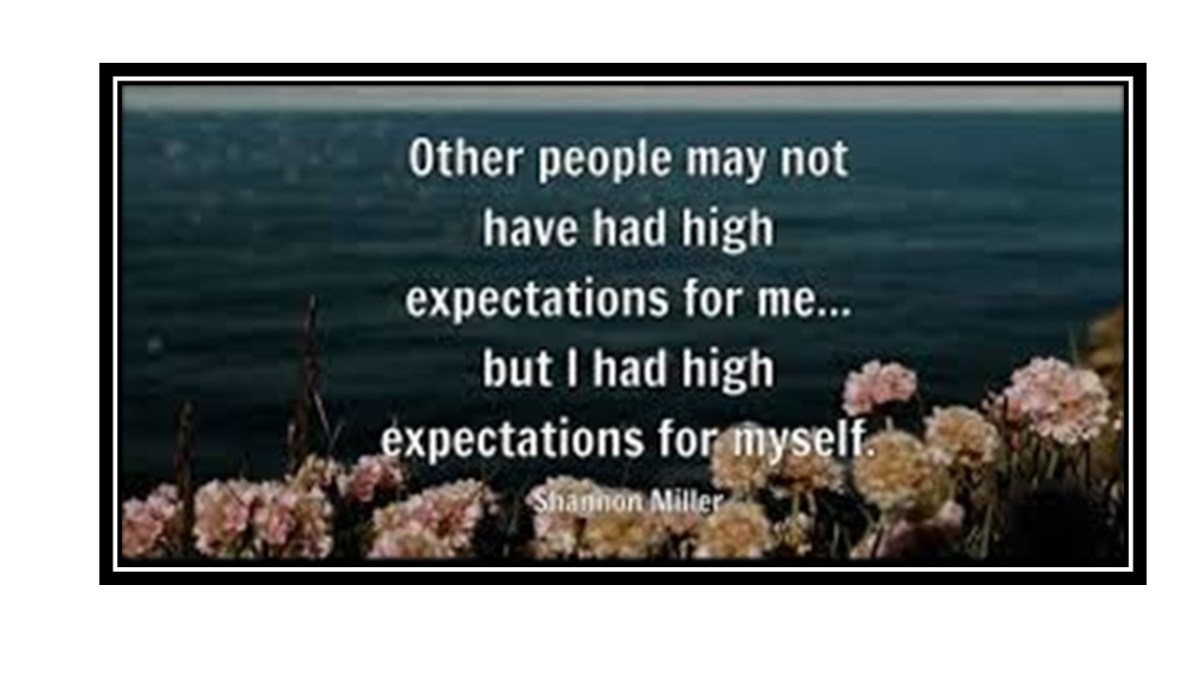
As you begin new opportunities, it’s important to set high expectations. Far too many people have the “getting by” mentality. For example, they will set low goals so they can do the least amount of work to get by. There is much more to life than just getting by. You are way better than just being average.

The truth is that we should have high expectations for ourselves. This is how we grow. This is how we achieve the life of our dreams. Having high expectations is what motivates us to strive for success. Setting goals and having high aspirations in life is essential for achieving our dreams.

It all starts with a positive mindset, which will enable you to accomplish your goals. When we expect great things to happen, we must understand that it’s going to require a lot of effort. It all starts with a positive attitude. You have to set challenging goals and have that burning desire to achieve them. When you have high and great expectations, you must believe in yourself and your full potential to succeed.

This mindset motivates you to work harder, and when setbacks come, you will be much more resilient. There are so many benefits when it comes to having high expectations. You will find yourself more motivated to be working towards your goals. You will find yourself feeling more confident about stepping out of your comfort zone.

High expectations will allow you to push yourself to work harder and achieve more. You must understand that setbacks will occur, but you will be more likely to bounce back quickly because you believe that true success is possible.

If you have found yourself having low expectations, you can change that. First, start by setting challenging and realistic goals. This will help you to stretch outside of your comfort zone. When you have challenging goals, you will be much more inspired and you will work harder to achieve them. No matter what happens, always stay positive and always believe in yourself. Keep an attitude of gratitude and surround yourself with positive people that will encourage you and lift you up. Use every setback that comes as a learning experience. Obstacles are not problems. They are opportunities to help you learn and grow. You may need to make some adjustments, but keep working towards your goals.

Most of all, you must take action. It’s not enough to just set big goals and have a positive attitude. You must be consistent daily in your work habits. Action is the true key to success. Stay committed to your goals and keep applying yourself. In order to live a fulfilling and successful life, you must have great expectations.

The journey may not be easy, but I guarantee you that the rewards are worth the time that you put in. Surround yourself with winners and take steps every day towards your vision of success. No more small time thinking. It’s time to think big and have great expectations. You’ve got this!

Happy Selling,

David

FRIDAY’S TOP 10 Will I Be Successful Prospecting? – Self Evaluation

Over the years, and after working with thousands of salespeople, I’ve found these ten questions determine your success in prospecting.

I’m going to walk you through ten questions, and I want you to answer truthfully. The total number of yes’s or no’s are going to help you determine whether or not you’re going to be successful prospecting.

At the end, scroll down to see what your results mean!

From the Home Office in Poughkeepsie, New York

Here are The Top 10 Questions on will I Be Successful Prospecting?

10. Do I have a dedicated time to prospect daily or weekly, and do I honor those times? 

People who are successful do not deviate from prospecting. They have a regular time and they stick with it. 

9. Do I know the number of conversations I need to have each week to keep my pipeline full? 

In other words, salespeople who succeed know the numbers they need to achieve, and they’re absolutely fixated on achieving those numbers. They know if they do, they can meet or exceed their goals.

8. Do I have a clear definition of who my ideal customer is?

How clear is your ICP—Ideal customer profile? It’s not just throwing mud against the wall, but rather making sure I’m absolutely laser-focused on just those who are my ideal customers. Otherwise your pipeline gets clogged with dead ends.  

7. Do I have at least five questions I can ask a prospect to engage them quickly?

What am I going to do if they actually answer the phone? I need five questions I can ask a leader or prospect to foster a conversation that will lead to another one.

6. Do I have a clear definition of what it takes to move someone from just a name to a qualified lead? 

Do I know exactly what the criteria is that they have to achieve?  I have to see something to know this is more than just a name. 

5. Do I review my prospecting activities before each day to ensure I’m clear on my goals? 

If I don’t know where I’m starting, and I don’t know where I finish, I’m lost. Instead, get absolutely focused on what your specific prospecting activities for the next day are. The key is to do it the night before, or work day before. Write it down and you’ll hit the ground running each morning. 

4. Do I have a defined process to get referrals?

So many salespeople fail to leverage referrals. That’s part of prospecting, too. 

Referrals are a key way to get more business because they’re practically pre-qualified.

3. Do I have a detailed follow-up process? 

We don’t close deals with one call unless you’re selling pencils. Do I have a very succinct follow-up process as part of my cadence?

2. Is all my prospecting communication centered around the needs of the prospect or are they screaming of how wonderful I am? 

Sometimes you can tell this by who talks more on a prospecting call. Do you get caught up talking about your experience or resume, or do you ask questions in order to sit back and listen?

And the #1 FRIDAY’S TOP 10 Will I Be Successful Prospecting is …

1. Do I hold firm to a solid discovery process with any lead before even thinking about a demo? 

I don’t try to race forward until I’ve first done discovery to truly understand what their need is.


If you answered YES to eight or more, you’re a top performer when it comes to prospecting. 

YES to five to seven? You’ve got potential, but you need to step it up. 

YES to four or fewer… in your current state, you have little chance at being successful.

Ask yourself this question. Was I truthful? Would someone who knows me, or someone who works beside me score me the same way? 

Have a great weekend,

David