Friday’s Top 10 Funniest Merchant Services Objections

Listen, we know the drill. You’ve spent all morning cold-calling in the rain, your shoes are squeaking, and you just want one merchant to look at their statement without acting like you’re asking for their firstborn. Sometimes, the only thing that keeps us sane in the world of merchant services is the sheer absurdity of the “NO.”

From the “I don’t believe in electricity” crowd to the merchants who treat their current bank like a long-lost lover, we’ve heard it all. Grab a lukewarm coffee and enjoy our definitive countdown of the most ridiculous objections we’ve ever encountered in the field.

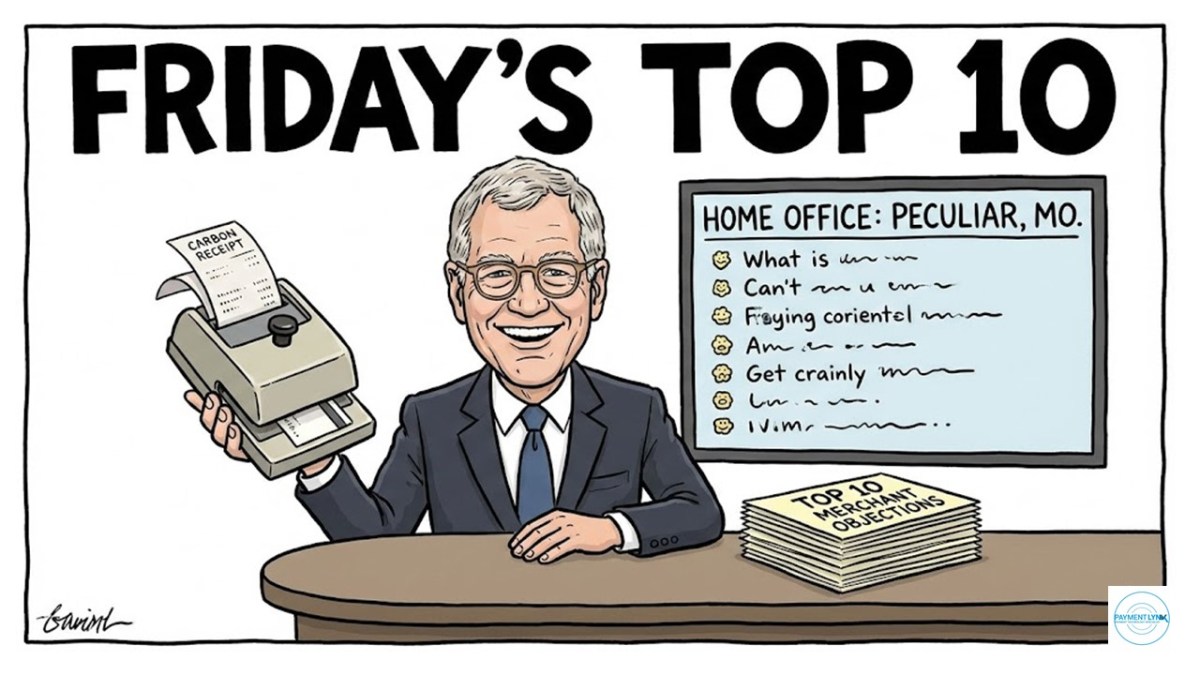
From the Home office in Peculiar, Missouri! Here are the

Top 10 Funniest Merchant Services Objections

10. The “Nephew in the Garage”

“My nephew is actually building a custom payment gateway in his basement right now. He says it’ll be ready by 2027 and it’ll be totally free.”

The Reality: We love family loyalty, but unless your nephew is Jack Dorsey, you’re basically saying you’d rather use a potato as a terminal than save 50 basis points today.

9. The “Retrograde” Defense

“I can’t sign anything today. Mercury is in retrograde, and my psychic told me that any new financial contracts signed this week will lead to a plague of locusts in the kitchen.”

The Reality: Honestly? This is the most honest objection on the list. At least they didn’t blame their “manager who isn’t here.”

8. The “Paper Trail” Purist

“I don’t trust those little chips. I’m waiting for the industry to go back to those sliding ‘knuckle-buster’ machines. It’s more personal when there’s carbon paper involved.”

The Reality: Sir, it’s 2026. If we go back to carbon paper, we might as well start accepting pelts and spices as currency.

7. The “Aggressive Wealth”

“I’m actually making too much money right now. If I save any more on my processing fees, I’ll be in a higher tax bracket and it’ll be a whole thing. I’d rather keep overpaying.”

The Reality: This is the ultimate “suffering from success” flex. It’s the sales equivalent of being told, “I’m too hydrated to drink water.”

6. The “Ghost Partner”

“I need to talk to my partner about this.” You: “Great, are they in today?” “No. They live in a monastery in Tibet and only check their carrier pigeon mail once a quarter.”

The Reality: The “Ghost Partner” is the unicorn of the merchant world—everyone talks about them, but no one has ever seen them.

5. The “Bank Stockholm Syndrome”

“My bank charges me $400 a month in junk fees and they haven’t updated my terminal since the Clinton administration… but the teller gives my dog a biscuit, so we’re basically family.”

The Reality: That is one expensive dog biscuit. You could buy a literal Great Dane with the money you’d save by switching.

4. The “Security Paradox”

“I don’t want a smart terminal. If it’s connected to the internet, the government will know exactly how many sourdough loaves I sell.”

The Reality: We hate to break it to you, but if you have a smartphone in your pocket and a Facebook page for the bakery, the “secret” of the sourdough is already out.

3. The “Wait and See” (Until I’m Dead)

“I’m thinking about retiring in fifteen years, so I don’t want to complicate my life by changing my daily workflow right now.”

The Reality: Ah, yes. The classic “I have 5,475 days left, and I refuse to spend 10 minutes of one of them making more profit.”

2. The “Physical Threat”

“I’d love to switch, but my current processor’s sales rep is my ex-wife’s brother, and if I cancel, he told me he’ll stop bringing the good potato salad to the family reunions.”

The Reality: Now that is a high-stakes negotiation. You can’t put a price on a good Duke’s Mayo-to-potato ratio.

And the # 1 Top 10 Funniest Merchant Services Objections is …

1. The “Electricity Is a Fad”

“I’m thinking about moving the whole shop to a cash-only, barter-based system where we trade haircuts for artisanal firewood. It’s the future.”

The Reality: This was heard in a high-tech city center. It’s not an objection; it’s a lifestyle choice. Godspeed with the firewood, Larry.

Keep your head up out there. For every ten “Nephews in Garages,” there’s one merchant who actually wants to grow their business. When you find them, tell them Peculiar, Missouri says hello.

Have a great weekend,

David

How to Harness Your Strengths for Better Prospecting

Selling payments is a demanding mix of technical knowledge, persuasive communication, and unwavering resilience. But what if you could supercharge your prospecting efforts by simply leveraging your innate strengths? Forget trying to fit a mold; let’s explore how to harness your unique talents for prospecting success.

Understanding Your Strengths (and Weaknesses)

Before diving into strategies, take a moment to reflect on your strengths. What are you naturally good at? Are you a:

  • Relationship Builder: Do you effortlessly connect with people and build rapport?
  • Analytical Thinker: Do you excel at understanding complex data and identifying patterns?
  • Creative Problem Solver: Do you thrive on finding innovative solutions to challenges?
  • Persuasive Communicator: Can you articulate value propositions clearly and convincingly?
  • Highly Organized: Do you manage your time and tasks efficiently?

Identifying your strengths is the first step. Equally important is acknowledging your weaknesses. Knowing where you might struggle allows you to seek support or develop strategies to mitigate those challenges.

Matching Strengths to Prospecting Strategies

Now, let’s explore how to align your strengths with effective prospecting techniques:

1. The Relationship Builder:

  • Leverage Networking Events: Attend industry events, local chamber of commerce meetings, and business networking groups. Your natural ability to connect with people will shine in these environments.
  • Focus on Referral Programs: Cultivate strong relationships with existing clients and encourage them to refer new business. Your ability to build trust will make them eager to vouch for you.
  • Personalized Social Media Engagement: Engage with potential clients on platforms like LinkedIn, focusing on building genuine connections rather than just pitching your services.

2. The Analytical Thinker:

  • Data-Driven Prospecting: Utilize data analytics tools to identify potential clients based on industry trends, business size, and other relevant factors.
  • Competitive Analysis: Research your competitors’ offerings and identify opportunities to differentiate your services. Use this data in your presentations to show your superior knowledge.
  • Create Tailored Proposals: Analyze each prospect’s specific needs and create customized proposals that highlight the value you can provide.

3. The Creative Problem Solver:

  • Develop Unique Value Propositions: Think outside the box and create compelling value propositions that address the specific challenges faced by your target market.
  • Offer Innovative Solutions: Instead of just selling a product, focus on providing customized solutions that streamline payment processing and improve their business operations.
  • Utilize Content Marketing: Create engaging content, such as blog posts, videos, and infographics, that showcase your expertise and attract potential clients.

4. The Persuasive Communicator:

  • Master the Art of Storytelling: Craft compelling stories that illustrate the benefits of your services and resonate with your audience.
  • Practice Your Pitch: Refine your sales pitch to be clear, concise, and persuasive. Focus on highlighting the value you bring to the client.
  • Active Listening: Pay close attention to your prospects’ needs and concerns, and tailor your communication accordingly.

5. The Highly Organized:

  • Implement a CRM System: Utilize a CRM system to manage your leads, track your progress, and stay organized.
  • Develop a Consistent Follow-Up System: Create a system for following up with prospects, ensuring that no leads fall through the cracks.
  • Time Management: Prioritize your tasks and allocate your time effectively to maximize your productivity.

Embrace Your Uniqueness:

The key takeaway is that there’s no one-size-fits-all approach to prospecting. By understanding and embracing your strengths, you can develop a personalized prospecting strategy that aligns with your natural abilities. This will not only make your job more enjoyable but also significantly increase your chances of success.

Remember, authenticity is your greatest asset. When you’re genuinely passionate about what you do and confident in your abilities, it shines through and resonates with potential clients. So, unleash your superpowers and watch your prospecting efforts soar!

Happy Selling,

David

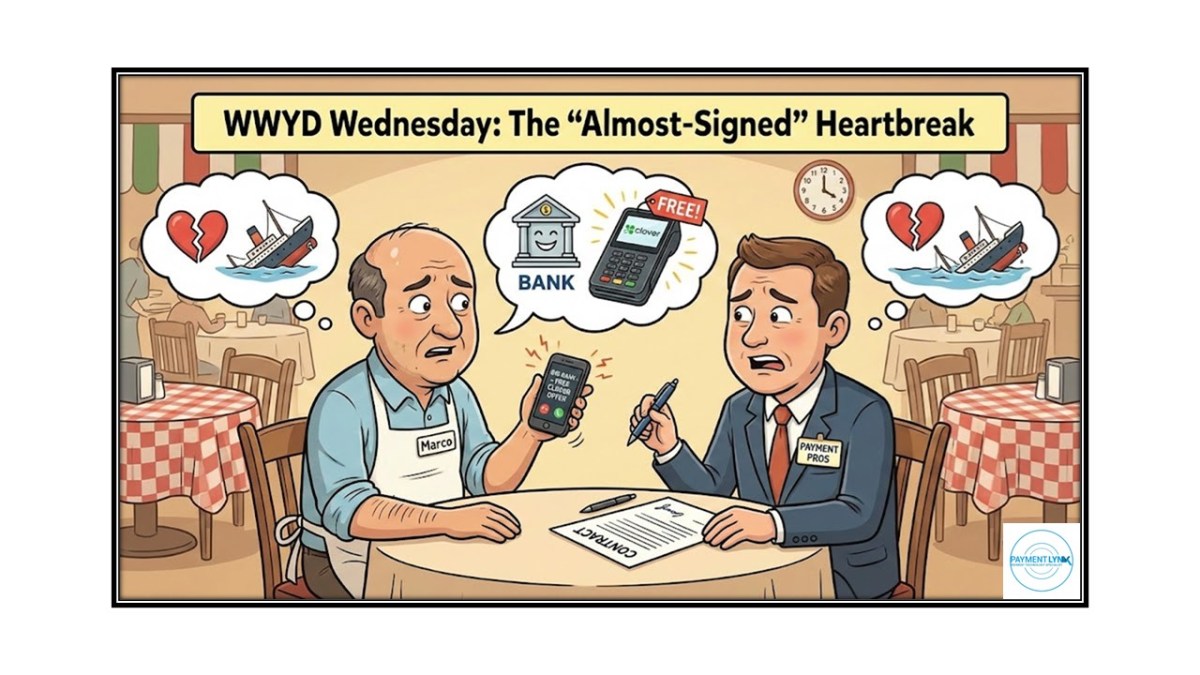
WWYD Wednesday: The “Almost-Signed” Heartbreak

We’ve all been there. It’s 4:00 PM on a Tuesday. You’ve visited that local Italian spot three times. You know the owner’s name (it’s Marco), you know his daughter just started college, and you finally convinced him that his current processor is eating his margins alive with hidden “PCI Non-Compliance” fees.

The contract is on the table. You’ve got your favorite pen ready. Then, Marco’s phone buzzes.

He looks at it, frowns, and looks back at you. “Listen, I really like you. You’ve been great. But my bank just called. They said if I stay with them, they’ll cut my rate by another 10 basis points and throw in a brand-new Clover Station for free. I want to work with you, but I can’t leave money on the table. What should I do?”

Your heart sinks. You’ve put in the hours, and now a “free” piece of hardware and a tiny rate cut are about to blow up the deal.

The Reality Check

In merchant services, we aren’t just selling a terminal; we’re selling advocacy. The bank sees Marco as an account number. You see him as a partner. But when a merchant is looking at a “free” $1,200 piece of equipment, logic often goes out the window.

So, What Would You Do?

Here are three ways to handle this. Which one matches your style?

Option A: The “Math” Defense You pull out the calculator. You show him that 10 basis points on his $30k volume is only $30 a month. Then, you show him the “Equipment Lease” or “Service Agreement” fine print in the bank’s offer. Is that “free” Clover actually free, or is there a 48-month non-cancelable contract hiding in the shadows?

Option B: The “Personal Service” Pivot You look him in the eye and say, “Marco, when that Clover stops working at 7:00 PM on a Friday night during your dinner rush, who are you going to call? A bank 1-800 number with a 40-minute hold time, or my cell phone? I’m the guy who drives over here with a backup unit in my trunk.”

Option C: The “Value-Add” Sweetener You realize you can’t beat “free,” so you change the game. You offer to integrate his online ordering or help him set up a loyalty program that will bring in 20% more customers. You move the conversation from “saving $30” to “making $3,000.”

What’s Your Move?

This is the “make or break” moment that defines a top producer. Do you walk away, drop your price even lower, or stand your ground on the value of your relationship?

Drop a comment below and let me know: How would you save this deal?

Happy Selling,

David

Don’t Take This the Wrong Way…

I was having coffee with a potential referral partner a couple of weeks ago—a guy in the mortgage industry. He’s a sharp guy, a college graduate, and a seasoned salesperson. But as we talked, he admitted he was really struggling to make it in this market. Then he said something that stopped me mid-sip:

“I look at people without a degree, like you, and I kind of look down on them. Now, don’t take that the wrong way…”

I didn’t take it personally. In fact, it got me thinking.

Here was a man with the “right” credentials and a prestigious-sounding job in mortgage lending, yet he was drowning. Meanwhile, I’m building a life of freedom without the diploma. It reminded me that in the real world, the market doesn’t pay for your pedigree—it pays for your positioning.

Let’s be honest: Sales is a brutal game.

In the mortgage world, or almost any other 100% commission based sales industry, you are on a relentless treadmill. You’re a hunter. You wake up on the first of the month, and your income is $0. You have to find a lead, hope they qualify, hope the appraisal comes in, and hope the deal closes just to get a check. Then, on the first of next month, you’re right back at square one.

  • A bad quarter? You’re on a performance plan.
  • A bad year? You’re out of a job.

You eat what you kill, and if the “prey” disappears because interest rates went up, you starve. But not us.

The Secret Weapon: The Residual Safety Net

We’re in merchant services. We have a secret weapon that changes the entire definition of winning and failing. It’s the reason why our “BAD” is better than most industries’ “GOOD.”

It’s called recurring residual income.

Think about my friend in mortgages. If he has a “bad month” and closes zero loans, his paycheck is non-existent. He’s under a mountain of stress because his past success doesn’t pay his current bills.

Now, what happens when you have a bad month in Merchant Services? You might hit a slump. You might get a string of “NOs.” You might sign zero new accounts for 30 days straight.

And yet, on the 25th of the month, a deposit still lands in your bank account. Why?

  • Because the restaurant you signed three years ago is still processing cards.
  • Because the auto body shop you signed last January just had a busy week.
  • Because every single “YES” you’ve ever gotten is still paying you, month after month.

In this industry, you aren’t just chasing a commission; you are building a floor for your income. ### The Ultimate Payday: Your Book is a Sellable Asset This is the part that separates the salespeople from the business builders.

If that mortgage guy quits today, his income hits zero tomorrow. But that “book of business” we’re creating isn’t just an income stream; it is a tangible, bankable asset.

Let’s say you’ve built a “decent” book that pays you $5,000 a month in residuals.

  1. In a normal sales job: You have a $60,000/year income that stops the second you stop selling.
  2. In Merchant Services: You have a $60,000/year income AND an asset that a larger provider will line up to buy from you.

At current multiples (20x or even higher), that $5,000/month book is a $100,000+ cash-out event waiting to happen. You can even walk into a bank and get a loan against your residuals because they are predictable and proven.

Keep Your Head Up. You’re Playing a Different Game.

So, back to my friend in the mortgage business. He might have the degree and the title, but he’s still a hamster on a wheel, running just to stay in the same place.

Don’t let anyone “look down” on your path. Is this industry tough? You bet. You will face rejection and days where you question your sanity. But remember: You are a builder. Every single “YES”—even that tiny $40/month deal—is a permanent raise.

You’re not just hunting for your next meal. You’re building an empire that will one day pay you to hunt, to sleep, or to do whatever else you want.

In this industry, even when you feel like you’re failing, you’re still stacking wins.

Happy Selling,

David

Rise and Shine, Woodchuck Chuckers!

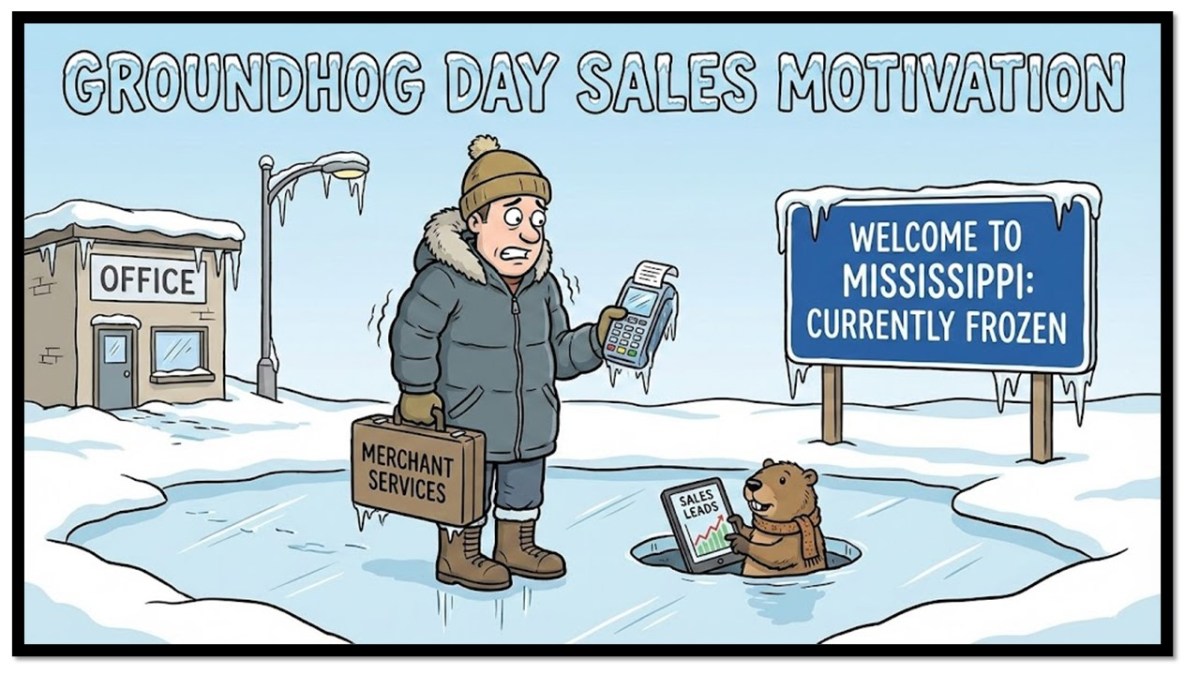
Is it Groundhog Day yet? t’s colder than a prospect’s face when you ask to see their merchant statement. I’m sitting here in Mississippi, and let’s just say the “Hospitality State” is currently giving us the “Cold Shoulder.” We are officially frozen. Between the ice on the windshields and the local news whispering about “potential snow” tomorrow, I’m starting to think Punxsutawney Phil isn’t just a rodent—he’s a master of psychological warfare.

But for those of us in Merchant Services, “Groundhog Day” isn’t just a holiday or a Bill Murray classic; it’s a career choice.

The “Loop” We Live In

If you’ve been in the payment processing game for more than a week, you know the cycle:

  • 7:00 AM: Wake up, check the leaderboard, realize you’re a “hero” who just reset to “zero.”
  • 9:00 AM: Walk into a local business.
  • 9:01 AM: Get told, “We’re happy with our current processor” by someone who hasn’t looked at their statement since the Obama administration.
  • 10:00 AM: Explain for the 400th time that “No, I am not with the bank, but yes, I can save you money.”
  • Repeat.

It’s easy to feel like Phil Connors, trapped in a loop where every “no” sounds the same and the coffee is always lukewarm. But here’s the thing: Phil didn’t escape the loop by doing the same thing. He escaped by becoming a master of his craft.

3 Ways to Break the Shadow This Month

1. Don’t Be Afraid of Your Own Shadow (or the Gatekeeper) Phil gets scared of his shadow and runs back into a hole for six weeks. Don’t be Phil. In sales, your “shadow” is that lingering doubt or that one “mean” business owner down the street. If you retreat every time you see a grimace, you’re looking at six more weeks of a cold pipeline. Direct eye contact, a genuine smile, and a “Hey, I see you’re busy, I’ll be brief” ” How long you been open?” goes a long way.

2. Learn the Piano (Metaphorically) In the movie, Phil learned to play the piano, speak French, and ice sculpt. In Merchant Services, your “piano” is the Statement Analysis. If you’re still just selling on “price,” you’re stuck in the loop. Master the tech—Dual Pricing, Cash Discounting, the new POS integrations. When you become the expert, the loop stops being a prison and starts being your playground.

3. Mississippi-Proof Your Pitch If I can pitch merchant services while my state is basically a giant popsicle, you can handle a little “rejection” in the AC. Use the weather!

“I figured I’d drop by before the snow hits on Tuesday—if your current processor is as frozen as my driveway, we should probably talk about a backup.

Whether that furry little meteorologist sees his shadow or not, Spring is coming. The deals are out there, hiding under the ice. You just have to be the one willing to dig them out.

So, grab your parka, keep your statement-analyzer handy, and remember: If you do it right, you only have to close them once!

Happy Selling,

David

Friday’s Top 10 Things You Might Not Know About Groundhog Day

Happy Friday everyone! While we’re all bundled up waiting to see if Punxsutawney Phil sees his shadow this Monday, Groundhog Day, let’s dive into some fascinating facts about this quirky tradition.

From the Home Office in Punxsutawney, Pennsylvania,

Here are this Friday’s Top 10 Things

You Might Not Know About Groundhog Day

10. It’s Older Than You Think: Groundhog Day’s roots trace back to ancient European traditions, with Candlemas Day being a key influence. Early Christians believed sunny skies on Candlemas meant a longer winter.

9. Phil’s Got a Posse: Punxsutawney Phil isn’t just some random groundhog. He’s got an “Inner Circle” of top-hat-wearing handlers who care for him year-round and translate his “predictions.”

8. He’s a Bit of a Celebrity: Phil’s met presidents, appeared on Oprah, and even starred in his own movie (sort of). He’s the Brad Pitt of the groundhog world.

7. Groundhogs Are Terrible Meteorologists: Statistically, Phil’s accuracy rate hovers around 39%. You’d have better luck flipping a coin to predict the weather.

6. It’s Not Just a “Phil” Thing: While Punxsutawney Phil is the most famous, groundhogs across North America participate in this tradition. Canada has Wiarton Willie, and Georgia has General Beauregard Lee.

5. They Were Once Dinner: In the early days of Groundhog Day, the tradition sometimes involved eating the groundhog. Thankfully, that’s no longer part of the festivities.

4. Groundhogs Are Whistle Pigs: These furry critters get their nickname from the high-pitched whistles they use to communicate with each other.

3. They’re Expert Burrowers: A groundhog burrow can be up to 50 feet long and 5 feet deep, with multiple escape routes! Talk about a luxury condo.

2. Phil’s a Vegetarian: No shadow-hunting for this guy! Groundhogs primarily munch on grasses, plants, and fruits.

And the # 1 Top 10 Things You Might Not Know About Groundhog Day is …

1.”Groundhog Day” the Movie Wasn’t Filmed on Location: Despite the film’s popularity, none of the scenes were actually shot in Punxsutawney, Pennsylvania. Filming took place in Woodstock, Illinois.

So, there you have it! 10 fun facts to impress your friends with this Groundhog Day. Enjoy the festivities, and here’s hoping for an early spring!

Have a great weekend,

David

How Often Do You Follow Up?

I recently saw a thread in a Facebook group for ISOs and agents where the “Never Stop” mentality was on full display. When someone posted and ask, asked, how often to follow up and when to quit, and the veterans didn’t hold back.

Here are just a few of their responses. Michael Nardy noted: “I stop when the owner has died or sold the company. Then I start with the new owner or his next of kin. This is sales!”

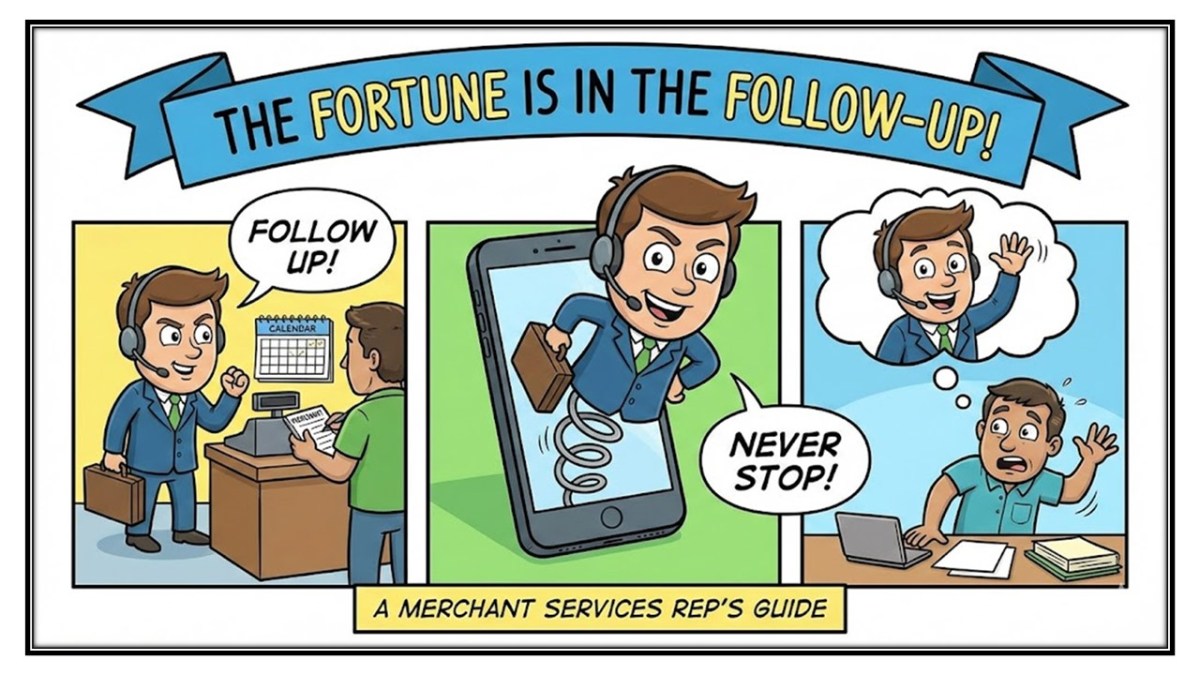
The F.U. Money/the Fortune is in the Follow-Up

Steven Morris hit the nail on the head in that same thread. He reminded us that this isn’t just about being annoying—it’s about the fundamental math of success: “Never stop following up—The fortune is ALWAYS in the follow-up. Consistency breeds discipline and discipline breeds results. I have merchants that have taken me years to sign up.”

The Rite of Passage: The Story of “NO”

Every single veteran in this industry has a story. We’ve all been told “NO” time and time again. We’ve been hung up on, walked out on, and ignored for months. If you’re feeling discouraged because a prospect shot you down, remember: you’re in good company.

The difference between the top producers and the ones who wash out in six months isn’t the number of “Yeses” they get—it’s how they handle the “Nos.” In merchant services, a “No” is rarely a final destination; it’s just a hurdle on the track.

When “No” Doesn’t Mean “No”

We’ve all dealt with the “tough” prospects. You know the ones—the merchants who act like you’re ruining their day just by existing. One agent in the group shared just how far persistence can go: “You keep following up and asking different questions until they tell you to stop. But I have had people literally tell me that they would rather eat their own sh*t—and I’ve switched them. You just have to do what everybody else isn’t.”

This is the reality of the street. Merchants are bombarded by reps. They use hostility as a defense mechanism to see who is serious and who will fold. When you keep showing up with value and a professional attitude despite their resistance, you earn a level of respect that a “one-and-done” rep will never touch.

The Follow-Up Cadence: How to Stay Disciplined

To do “what everybody else isn’t,” you need a system. Here is how to maintain that discipline without burning out.

1. The “Hot” Phase (Days 1–10)

If you just dropped off a proposal, the clock is ticking.

  • Day 1: Immediate “Thank you” email/text.
  • Day 3: Follow-up call to see if they’ve reviewed the numbers.
  • Day 7: Send a case study or a testimonial from a similar business.

2. The “Nurture” Phase (Months 1–6)

If they haven’t signed yet, stay top-of-mind.

  • Frequency: Every 3 to 4 weeks.
  • The Strategy: Don’t just ask “Are you ready?” Send them something useful, like a news clip about new surcharge laws or local business trends.

3. The “Long Game” (Year 1 and Beyond)

This is where the Steven Morris “years to sign” philosophy pays off.

  • Frequency: Every quarter.
  • The Strategy: Standard check-ins. Merchant contracts end, rates creep up, and bad customer service from their current provider will eventually happen. You need to be the person standing there when they finally snap.

The Golden Rule – Answer the Phone!

Persistence is useless if you aren’t reachable. The final piece of the “Never Stop” puzzle is being the most reliable person in their contact list.

As the thread pointed out: “When they call, you have to answer!” Most reps are great at the hunt but terrible at the service. If a merchant finally decides to switch after two years of you chasing them, and you don’t pick up that call, you’ve just handed that “fortune” to someone else.

the “No” you get today isn’t a “No” forever—it’s just a “Not right now.” The rep who wins is rarely the one with the lowest rate; it’s the one who was still standing there when the merchant was finally ready to switch.

Stay persistent. Stay disciplined. And never, ever stop.

Happy Selling,

David

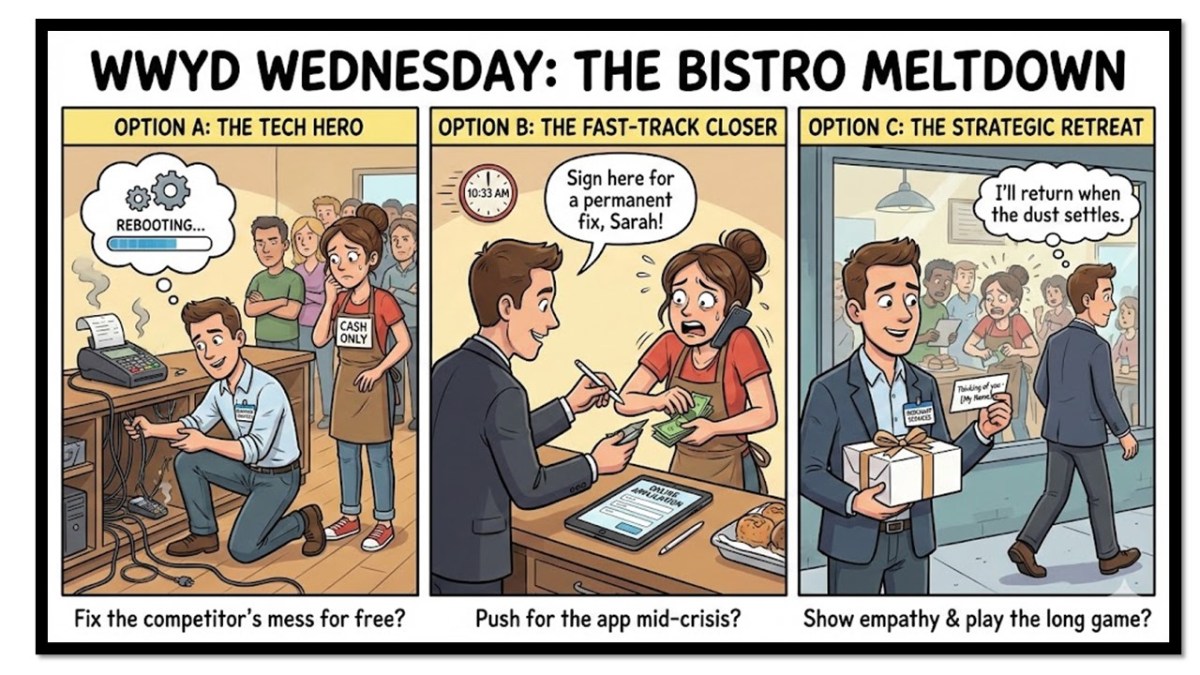
WWYD Wednesday: The Bistro Meltdown

We all know the feeling. You’ve been eyeing that high-volume bistro on the corner for months. They do massive numbers, their patio is always full, and you know your processing solution could save them a fortune.

You’ve tried calling. You’ve tried emailing. Nothing.

Finally, you decide to do a “warm drop-in” at say 10:30 AM—the sweet spot between the breakfast rush and the lunch crowd. But as you walk in, the air isn’t filled with the smell of roasting beans. It’s filled with panic.

The Situation

The POS system is completely frozen. The Wi-Fi is acting up, the credit card terminal is throwing a “Communication Error,” and there’s a line of ten caffeinated, impatient office workers waiting to pay. The owner, Sarah, is behind the counter frantically handwriting tickets and telling people “Cash only” while her soul visibly leaves her body.

This is the door-opener of a lifetime. But how do you walk through it?

Option A: The “Tech Hero”

You put your sales hat off and pull out your IT hat. You walk up to the counter and say, “Sarah, I’m [Name] from [Company]. I see your terminal is down. Don’t worry about a pitch right now—move over and let me see if I can reboot your gateway or check your IP settings.” * The Goal: Build massive, immediate “debt of gratitude” by fixing a competitor’s mess for free.

  • The Risk: You spend 45 minutes fixing a system you don’t even sell, and she’s too busy to talk to you afterward anyway, but you build massive trust…

Option B: The “Fast-Track Closer”

You realize her current provider has officially failed her. You wait for a 5-second gap in the line, lean in, and say: “Sarah, if they’re letting you down today, they’ll do it again. I can have a reliable, brand-new terminal in your hands by tomorrow morning so this never happens again. I just need you to fill out this quick online app on my tablet right now, and I’ll handle the rest.”

  • The Goal: Strike while the iron is hot. You’re offering a permanent solution to her temporary nightmare.
  • The Risk: Asking for an application (and sensitive info like a SSN or Bank ID) while she’s mid-crisis might feel tone-deaf or pushy.

Option C: The “Strategic Retreat”

You see the chaos and realize she’s in no state to make a decision. You go to the bakery next door, buy a box of croissants, walk back in, and hand them to her. You say, “Looks like a rough morning. Enjoy these with the staff when the dust settles. I’ll stop by tomorrow when you aren’t fighting fires.”

  • The Goal: Play the long game. You show empathy and high emotional intelligence.
  • The Risk: A competitor walks in ten minutes later with “Option B” and steals the account.

All of us in sales know that timing is everything. Are you the Technical Savior, the Fast Closer, or the Class Act?

Let me know in the comments below.

Happy Selling,

David

Beyond the Terminal: Why Passion for People Outperforms Product Knowledge

Yesterday, we talked about stopping the “perfection” trap and just getting out there. But once you’ve taken that first step and walked through the door, what’s the move? If you leading with price and hardware specs, you’re missing the heartbeat of this business.

We are officially in the last week of January. While others are still “getting ready,” the closers are out in the streets. But here’s the truth: if you’re not passionate about helping small business owners, you aren’t really in sales—you’re just an order-taker.

Selling payments isn’t about pushing credit card terminals; it’s about empowering the person behind the counter to reach their dreams.

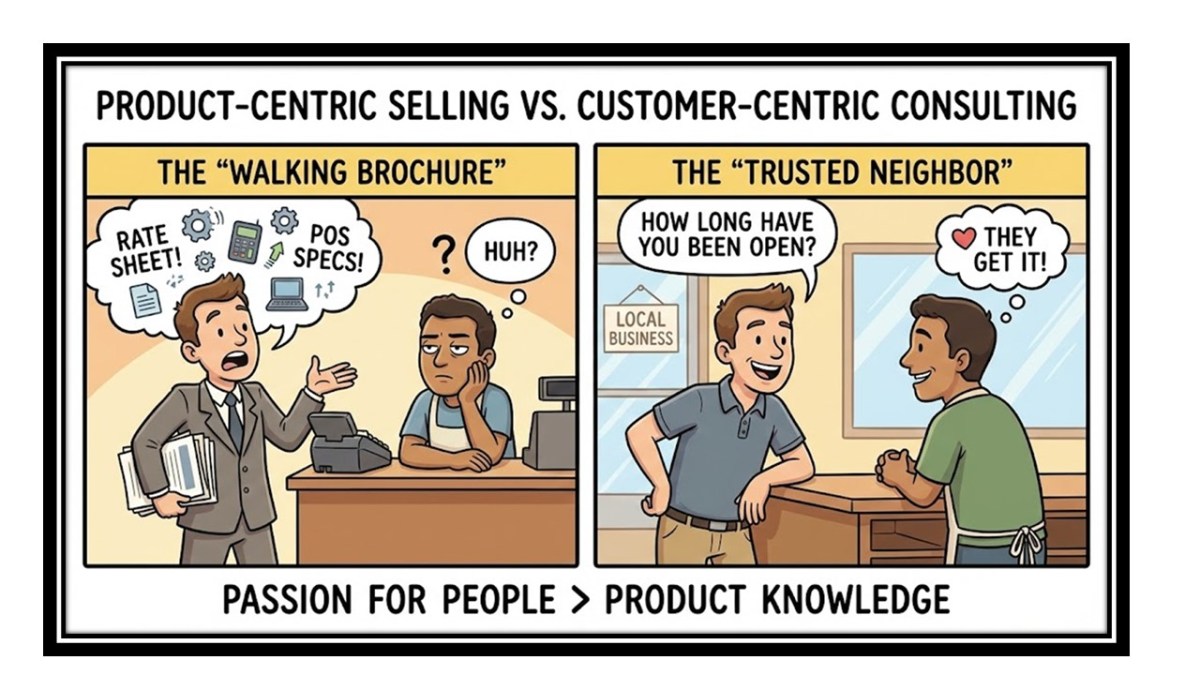
The Problem: Being a “Walking Brochure”

Too often, training focuses 100% on product knowledge—interchange-plus, surcharging, POS features. This creates “Product-Centric” reps who walk in and vomit facts.

The reality? The merchant doesn’t care about your hardware. They care about their problems. If you’re obsessed with your “killer sound system” while they just want “heated seats,” you’ve lost the connection—and the sale.

The Solution: The “Customer-First” Approach

Sales is a lifestyle. It’s about genuinely caring. When you lead with curiosity instead of a pitch, you become a trusted advisor.

I use a specific technique that works because it’s human. Don’t walk in as a “Sales Rep.” Walk in as a customer. Look around. Admire what they’ve built.

🎤 The “Customer-First” Pitch Drafts

Here are three ways to use this approach today. Notice how we don’t mention “Merchant Services” until the very end.

Option 1: The “Best Seller” Lead (Casual & Warm)

“Good morning! You know, I’ve driven past this place a dozen times and finally had to stop in. Everything looks great in here—how long have you guys been open? (Listen) Wow, that’s a great run. Quick question: what’s your absolute best seller? I want to try what the locals love. (Listen) That sounds awesome. I’m [Your Name], by the way. I’m local to the area—do you guys generally prefer working with local people for your business needs?

Option 2: The “Admirer” Lead (Focus on Growth)

“Hey there! I was just looking at your setup—it’s a great vibe. How long have you been at this location? (Listen) That’s impressive. You clearly know this neighborhood. Do you guys like to keep your business partnerships local, or do you deal mostly with the big national corporations? (Listen) I ask because I live right down the road and I help owners around here keep more of their hard-earned money…”

Option 3: The “Lifestyle” Lead (The Conversation Starter)

“Morning! I’m just checking out the shop—it’s got a great energy! How long have you been the owner here? (Listen) What’s the most popular thing you have today? (Listen) I love that. I actually just finished up an installation for a new POS system/terminal down the road at [Name of Business], and it made me realize I hadn’t stopped in here yet. I’m local to the area—do you value having a local partner you can actually call when you need something, or are you stuck with a 1-800 number?”

The Takeaway:

  • Shift your focus: Stop looking for a “sale” and start looking for a “solution.”
  • Ask questions first: Understand the person before you pitch the product.
  • Be passionate: Let your genuine desire to help shine through.

People quickly forget what you said, but they never forget how you made them feel. Your passion—and your local presence—is your biggest competitive advantage.

Happy Selling,

David

🛑 Stop Waiting for “Perfect” – Your Q1 Goals are on the Line

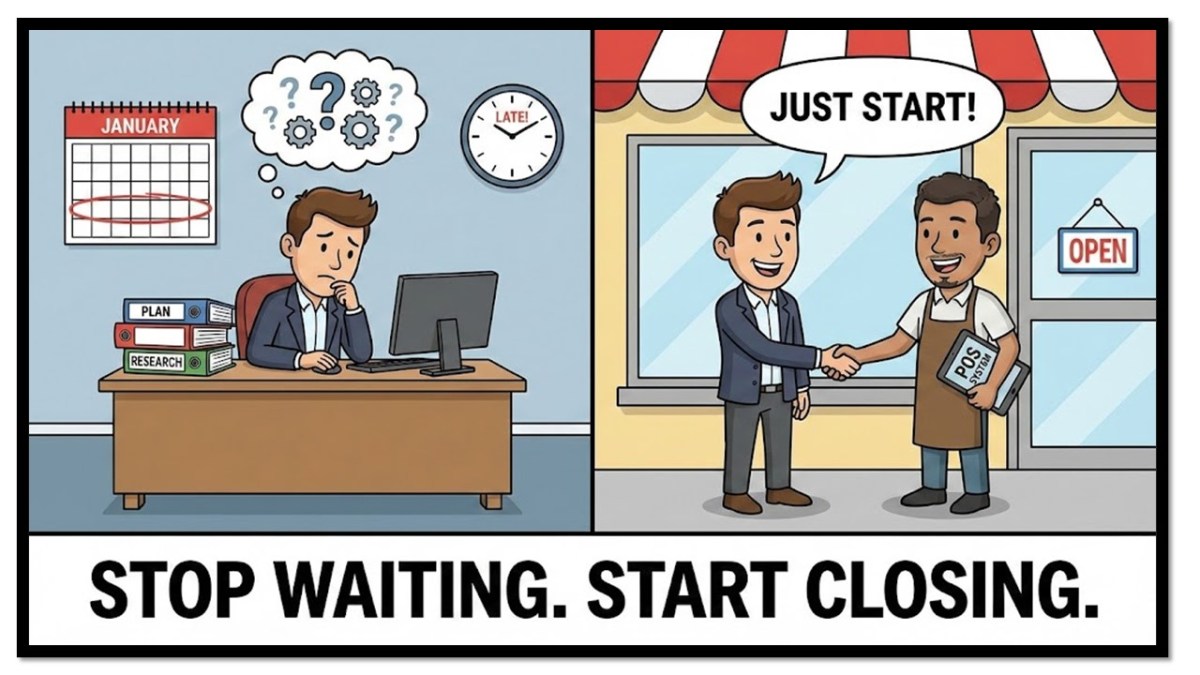
We are officially in the last week of January. While most people spent the first three weeks “getting organized,” “waiting for the phone to ring or car to take them to prospect,” or “waiting for the right leads,” the top 1% of producers have already been out in the field closing.

So many sales professionals stall their momentum because they feel they need to be a technical expert on every POS system or an underwriting guru before they walk into a business. This “perfectionism” is a residual killer.

You’ll Never Have All the Answers

The truth is, you’re never going to be 100% ready. Technology changes, every iso supposedly has the most compliant cash discount program, and every merchant has a unique pain point. If you wait until you know everything, your competition will have already signed the storefronts on your block.

That fire you felt on January 1st—the desire to build a massive residual portfolio—is there for a reason. But that portfolio won’t build itself. It’s time to pick up the phone or walk through the door.

Action is the Only Cure for Fear

Starting a new territory or a new sales push is intimidating. But the hardest part isn’t the “NO” from the merchant—it’s the resistance you feel before you even pull into the parking lot.

  • 70% of sales reps delay their outreach due to a fear of rejection or “analysis paralysis.”
  • Momentum is built by doing. Confidence is earned through the “NO’S” that eventually lead to a “YES!.”
  • Growth never happens inside your comfort zone. It happens when you’re standing at a counter, pitching a skeptical owner, and finding a way to add value on the fly.

Eliminate the “Somedays”

I’ve met too many reps living in the “somedays.”

  • “Someday I’ll have the perfect pitch.”
  • “Someday I’ll target the big enterprise accounts.”
  • “Someday I’ll be a top producer.”

There is no perfect moment. The only thing standing between you and the residuals you want is the story you keep telling yourself about why you aren’t ready.

Your Action Plan for the Week

Today is the day to reset. Write out your daily call/walk-in goals. Surround yourself with the “closers” in this office who will push you, not the “complainers” who will hold you back.

You might feel like you don’t have the “perfect” answer for every objection. It doesn’t matter. Start right where you are, with what you know, and learn the rest while you’re in the game.

The bottom line is simple: JUST START, JUST DO IT!

Happy Selling,

David