
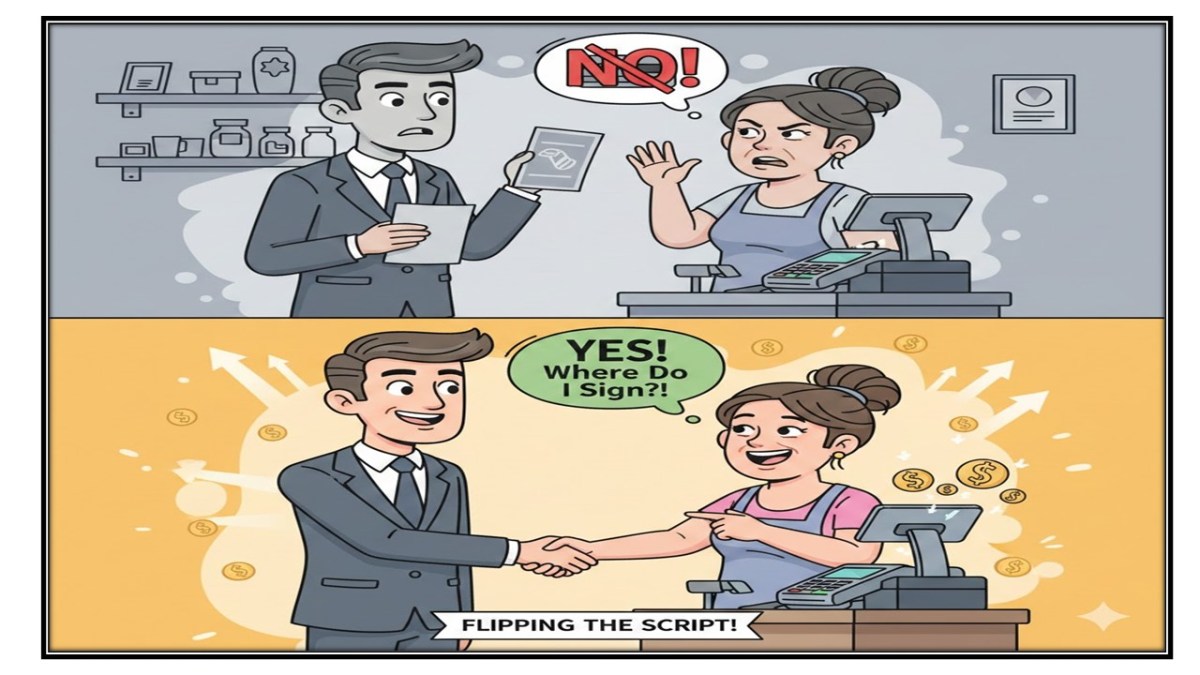
The word “No” is as common as a morning cup of coffee. You walk into a local business, mention credit card processing, and before you can even finish your sentence about “Dual Pricing,” the owner is already shaking their head.
But here’s the secret the top 1% of ISOs and agents know: A “No” is rarely a final rejection. Usually, it’s just a request for more information.
If you want to stop burning leads and start closing more deals, you need to learn how to pivot. Here is how to turn those “No’s” into “Yes’s.”
1. Decode the “No”
Not all rejections are created equal. To flip the script, you first have to understand what kind of “No” you’re dealing with.
| The Response | What They Actually Mean | Your Strategy |
| “I’m too busy.” | “I don’t see the value in giving you 5 minutes.” | Acknowledge their time and offer a specific, short window later. |
| “I’m happy with my current provider.” | “Switching is a headache I don’t want to deal with.” | Focus on the “Invisible Leaks” (hidden fees) they haven’t noticed. |
| “Your rates are too high.” | “I don’t understand the total cost of ownership.” | Shift the focus from price-per-swipe to bottom-line ROI. |
2. The “Feel-Felt-Found” Technique
This is a classic for a reason. It builds empathy and removes the “pushy salesperson” vibe.
- Feel: “I completely understand why you feel that way about switching; it seems like a giant administrative burden.”
- Felt: “Many of my most successful clients felt the exact same way when we first spoke.”
- Found: “What they found was that our concierge onboarding took less than 20 minutes of their time, and they ended up saving $400 a month.”
3. Stop Selling Price, Start Selling Peace of Mind
If you lead with “I can save you 10 basis points,” you’re a commodity. If you’re a commodity, you’re easily replaceable.
To get to a “Yes,” find the operational pain. Ask questions like:
- “How often do you have to call support and wait on hold for an hour?”
- “Does your current terminal integrate with your inventory system, or are you doing double the work?”
- “When was the last time your current rep actually walked through your door to do a check-up?”
4. The Power of the “Micro-Yes”
The jump from “Hello” to “Sign this three-year contract” is too big. You need to build a ladder of “Micro-Yes’s.”
Instead of asking for the sale, ask for:
- “Would it be okay if I just took a look at one statement to see if you’re being overcharged?”
- “If I could show you a way to eliminate your processing fees entirely through a dual-pricing model, would that be worth a 5-minute chat?”
5. Use the “Negative Reverse”
Sometimes, the best way to get a “Yes” is to lean into the “No.” If a merchant is being particularly resistant, try this:
“You know, Mr. , it sounds like you’re 100% set with your current setup and there’s absolutely nothing that could be improved. Should we just shake hands and I’ll check back in a year, or is there one small thing about your current provider that bugs you?”
This takes the pressure off and often causes the merchant to lower their guard and tell you their real complaint.
the sale doesn’t start until the customer says “No.” Every rejection is an opportunity to peel back a layer of their business and find where you can actually provide value.
Stop pitching and start problem-solving. When you solve a business owner’s problems, the “Yes” follows naturally.
Happy Selling,
David

 Payment Lynx Daily