
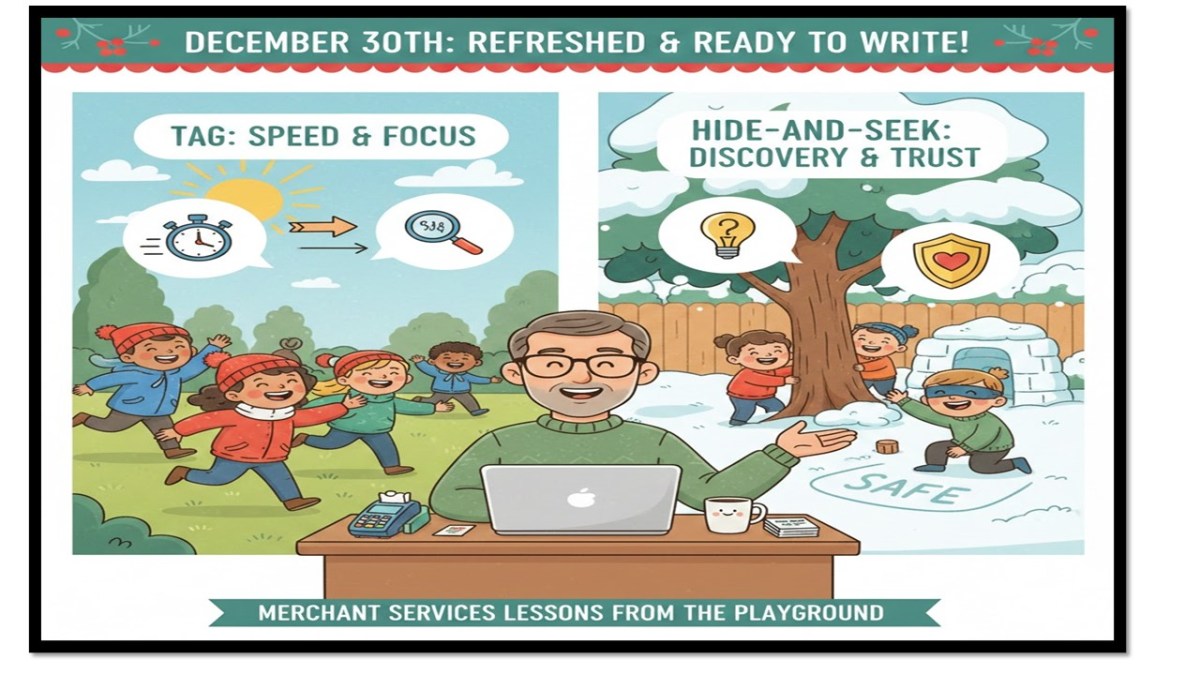
It’s December 30th, and after a glorious, much-needed week off, I’m back in the saddle! My brain is officially cleared of email backlog and deadlines, and instead, it’s filled with the delightful, chaotic memories of Christmas break.
For the last seven days, my home has been the unofficial headquarters for holiday fun. My own grandchildren, along with half the neighborhood kids, were constantly tearing through the yard, fueled by cookies and holiday excitement. The primary activities? Hide-and-Seek and Tag.
And, surprisingly, watching all that running, giggling, and strategy got me thinking about us—the business of selling merchant services.
The Game of Tag: Speed and Focus
When a child is “It” in the game of Tag, what’s their goal? To make contact with the next person as quickly as possible. Every moment counts.
The Merchant Services Parallel:
In our industry, the “It” is the new technology. The goal is to get that solution in front of the right business owner before a competitor does, or before the business owner resigns themselves to the status quo.
- Speed: If a business has a pain point (high fees, outdated terminals), the first provider to clearly articulate a solution is usually the one who wins. We must be fast in our follow-up and faster in our proposal delivery.
- Focus: You don’t just run blindly. You zero in on the one target who is closest or most vulnerable. In sales, this means identifying the business that is truly ready for a change, has the highest need, and represents the best long-term fit. Don’t chase everyone; focus on the ones you can truly help now.
Hide-and-Seek: Discovery and Trust
In Hide-and-Seek, the players go silent and disappear, hoping to go undetected. The “Seeker” must methodically check every location, be patient, and ultimately, discover the hidden player.
The Merchant Services Parallel:
The “hidden player” is the true objection or underlying concern of a prospect. They might say, “I’m not interested,” or “My current provider is fine,” but the real reason for their hesitation is often hidden.
- The Seek: Our job isn’t to blast features; it’s to ask the right, quiet questions to discover the real reason they are resistant to change. Is it fear of downtime? Uncertainty about a new agreement? A bad experience with a previous provider?
- The “Ally” Seeker: Unlike the playground, our goal is not to “catch” the prospect. It’s to be a trusted advisor who helps them discover the value. When we find their hidden need (e.g., they didn’t know they could integrate their POS with their loyalty program), we’ve “discovered” the sale.
The Power of “Safe on Base”
In both games, there’s usually a designated “Base” or “Safe Zone.” It’s the place where, for a moment, the running stops, the fear of being tagged disappears, and you can catch your breath.
The Merchant Services Parallel:
This is what we must become for our merchants: Their Safe Zone.
In a world of confusing fees, non-stop sales calls, and confusing PCI compliance standards, businesses crave a single point of contact they can implicitly trust.
- Offer Stability: When a merchant knows they can call you directly with a terminal issue, a chargeback question, or a statement inquiry, they feel safe. This comfort stops them from feeling the need to run to the next ‘cheaper’ offer.
- The Ultimate Retention Strategy: Providing outstanding support—being their “Base”—is the single greatest long-term retention strategy we have. It turns a client into a partner.
What Will You Chase in the New Year?
Watching those kids run around, completely absorbed in their simple games, reminded me that success is often about sticking to the fundamentals: Speed, Focus, Discovery, and Trust.
My Christmas break gave me a refreshed perspective, and I’m ready to apply these playground lessons to the business of growing sales in the new year.
Here’s to a fast, focused, and prosperous final push to the end of the year!
Happy Selling,
David

 Payment Lynx Daily