
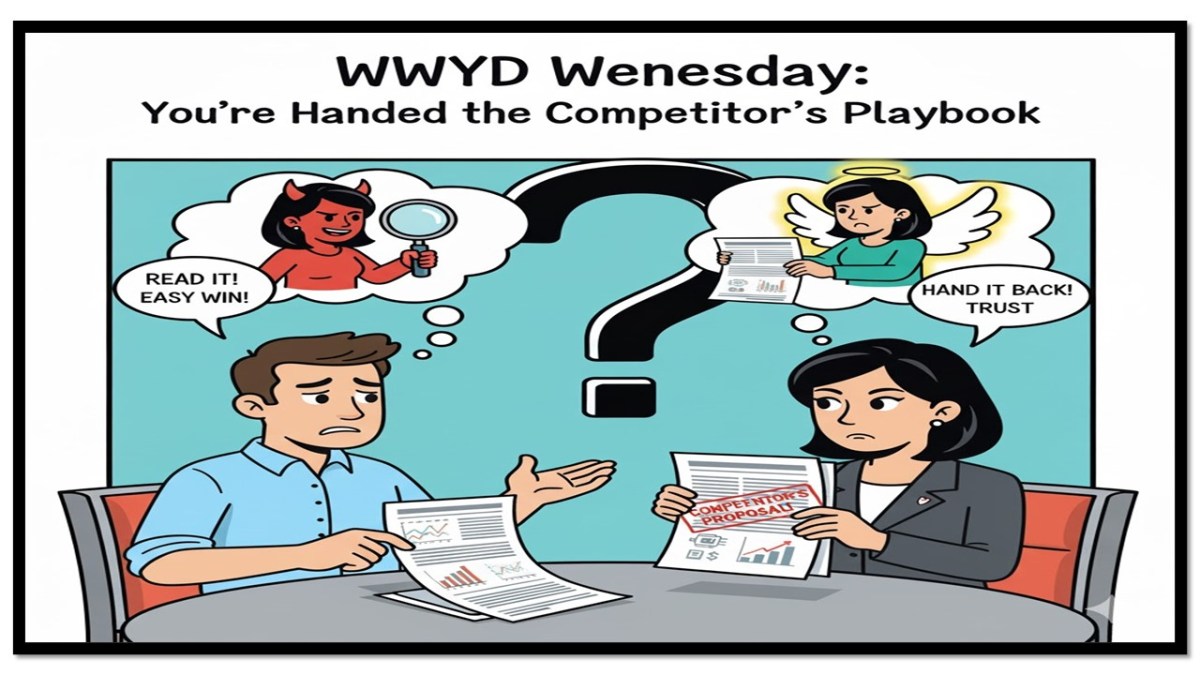
Welcome back to WWYD Wednesday, the series where we tackle the tough, ambiguous, and all-too-real situations that merchant services professionals face every day.
In our industry, we’re part-strategist, part-consultant, and part-psychologist. We’re used to navigating complex conversations. But every now and then, you’re faced with a choice that isn’t just about strategy—it’s about character.
This week’s scenario is a high-stakes ethical dilemma. Let’s set the scene.
The Scenario
You’re in a meeting with a high-volume restaurant owner who is unhappy with their current provider. They’re frustrated and want to show you exactly why.
“Look at this,” they say, sliding their most recent merchant statement across the desk.
You immediately recognize the statement format—it’s from your biggest local competitor.
As you pick it up to do your analysis, you see a second piece of paper stapled to the back of it, face down. Curious, you turn it over.
Your stomach drops.
It’s a full, detailed proposal from another competitor. It outlines their entire pricing structure, recommended equipment, and their complete strategy to win this exact account.
You look at the merchant. They’re busy complaining about their current rates and clearly have no idea it’s there. You’re holding the entire game plan to win this deal.
So, What do you do?
The Dilemma
Your brain is racing. This single piece of paper holds all the answers. You know their “best and final,” what they’re leading with, and what they think this merchant’s hot buttons are.
You could create a proposal that beats them by a few basis points, just enough to win the deal while maximizing your own profit. It’s a massive, unearned advantage, served up on a silver platter.
No one would ever know. Or would they?
Let’s break down the options.
Option 1: Read It. (The “Win at All Costs” Approach)
You discreetly scan the entire proposal. You absorb the pricing, the equipment notes, and the proposed solution. You then slide the statement back, “forgetting” to mention the paper on the back.
- The Pro: You gain an almost unfair competitive advantage. You know exactly what you need to do to win. You can perfectly position your solution against theirs and guarantee your pricing is sharper. In the short term, your odds of closing this lucrative account just went way up.
- The Con: This is the definition of a bad-faith negotiation. You’ve started the most critical part of a business relationship—the foundation of trust—with a lie of omission. What if the merchant sees you? You’re done. Instantly. But even if they don’t, you’ve set a precedent for yourself. Is this how you want to build your portfolio?
Option 2: Ignore It. (The “Pretend You Saw Nothing” Approach)
You see the proposal, and you immediately turn it back over. You ignore it. You proceed with your analysis of the statement as if you never saw the second page. You try to put it out of your mind.
- The Pro: You maintain your personal integrity (mostly). You haven’t used the information, so you can’t be accused of cheating. You avoid a potentially awkward confrontation with the merchant.
- The Con: This is a passive and weak position. The proposal is still right there. The merchant might find it later and wonder if you saw it. You’ll spend the rest of the meeting trying not to think about what was on that paper, which may unconsciously affect your own proposal. You haven’t built trust; you’ve just sidestepped a test.
Option 3: Hand It Back. (The “Integrity Play” Approach)
You stop the conversation. You hold up the stapled-together papers, turn the proposal face-down, and slide it back to the merchant.
You say, calmly, “You probably don’t want me to see this.”
- The Pro: In one 10-second act, you have completely changed the dynamic of the meeting. You have instantly demonstrated that your integrity is not for sale. You’ve just saved the merchant from making a huge mistake (showing their hand to you or, even worse, the next rep who walks in). You’ve moved from “salesperson” to “trusted advisor.”
- The Con: You lose the “easy win.” You give up all that juicy competitive intel. You now have to win this deal on your own merits, your own solution, and your own value proposition.
My Analysis
For me, it’s Option 3, and it’s not even close. It’s also the single best sales strategy.
The second you hand that proposal back, the merchant’s perception of you completely transforms. You’re no longer “the payments guy.” You’re the professional who just looked out for their best interest, even when it was a disadvantage to you.
Trust is the single most valuable currency in our industry. It’s worth more than any single deal.
That act of integrity is more powerful than any rate you can offer. The merchant now knows you’re not there to just “beat a quote.” You’re there to be a partner. They will be more honest with you about their business, more receptive to your solution (even if it’s not the rock-bottom cheapest), and less likely to shop you in the future.
You’re not just winning an account; you’re earning a client. And that’s how you build a long-term, referral-generating business.
What Would You Do?
That’s my take, but this is a tough spot.
- Is winning the deal the top priority, no matter what?
- Is there a middle-ground approach I missed?
- Have you ever been in a similar spot?
Leave a comment below and tell me exactly how you’d handle this. I want to hear your thoughts.
Happy Selling,
David

 Payment Lynx Daily