
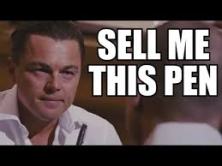
 Good Thursday morning everyone. Let’s keep sales movie week going with “The Wolf of Wall Street. Academy Award winner Leonardo DiCaprio stared in Scorsese’s excess-packed The Wolf of Wall Street – joining a long line of films
(Wall Street, Boiler Room, Glengarry Glen Ross) that cast the sales profession in it’s most negative light.
While millions of honest people make their living in sales, they rarely make movies about them (with the happy exception of The Pursuit of Happyness.) While Jordon belfort was morally bankrupt as displayed in this film, I can pass on one of several kernels of sales wisdom that made it worth the time to watch it. Sell me this pen from The Wolf of Wall Street. Let me set the scene:
Leonardo DiCaprio plays convicted stockbroker, Jordan Belfort and early in his career he is trying to turn a group of inexperienced, undisciplined misfits into junk bond salesmen. In order to show them how sales works, DiCaprio pulls out a pen and going around the room, thrusts it in their faces, one by one, with the instruction to “Sell me this pen.” see video below.
The “Sell me this pen” scene in the Wolf of Wall Street illustrates a fundamental selling point; one that is often rushed past in our enthusiasm to present product features and benefits. Until a need is recognized, it simply doesn’t matter how great your product and services are. I would add to that: until that need has a higher priority than your prospect’s other needs, it doesn’t matter either. A sales presentation or conversation that doesn’t uncover or address an urgent need is usually a waste of time.
So how do you identify a need and create the urgency to act on it? (After all, only in the movies is grabbing something from your prospect and then trying to sell it back to them a viable tactic.) Lets look at each separately:
1. Identifying needs
Often the need is not readily apparent to the prospect, or buried under a lot of other wants and needs. You can probably recognize this in yourself: Perhaps you have a project that you know you “need” to get done, but it keeps getting put off as you get distracted by life or other things that come up. Or, you’ve been living with your “work-around” solution so long that you start to convince yourself you don’t need to fix it, upgrade it or change it altogether. People can lose sight of their needs when overwhelmed with too many responsibilities and decisions. This is where merchant services sales professionals can serve an important role.
We are in a unique position to help our merchants step back and take a more objective view of their needs through a discovery session or needs analysis. This is the basis of consultative selling, to ask probing questions that reveal pain and discover underlying motivations. These are things you can find out when you do a good discovery.
But what if a need is not obvious or our product is new – as is the case with much of our processing technology?
We have to establish the need and a merchants desire to change by highlighting the differences between what they currently have – and what they can potentially have by delivering a compelling value proposition such as upgrading from a VX520 to a touch screen POS.
2. Creating Urgency
Keep in mind that I am not referring to the manufactured “This is the last time we can offer this price” or “I have another solution to offer” type of urgency. Although occasionally true, merchants can smell false pressure tactics a mile away. The sales person who screams a “fire sale!” too often is taken as seriously as the boy who cries “wolf!” I am talking about authentic urgency: addressing needs that have been pushed aside or given a lower priority than perhaps they deserve.
As merchant services sales professionals, we have a responsibility to raise the potential consequences of indecision or making a poorly informed decision to our prospects and merchants. Everyone has experienced wanting something, sitting on the fence too long and regretting it. As sales professionals, you have the power to help someone avoid this painful experience.
3. Raising the Stakes
Have you ever seen a movie where the character’s needs are not of the utmost urgency? Probably not as they don’t get made. A film about a character who is not convinced he needs to solve his or her problem immediately (or at least in the next two hours) is a film that goes nowhere. A prospect who is not convinced that he has to solve his problem quickly, is a sale that goes nowhere.
You can help a prospect or merchant reconnect with his needs and the urgency to act upon them by using a simple but effective technique from the movies called Raising the Stakes. By making a series of associations and solutions to meet a merchants needs you can help re-prioritize a decision and bring to light the consequences of either indecision or a poor decision to the right decision.
Now go out and sell a point of sale system.
What sales tips have you learned from the Wolf of Wall Street?
email me below.
For more information about joining Payment Lynx and growing your portfolio or to discuss keeping momentum going in July please feel free to contact me at DMatney@PaymentLynx.com or 833-729-5969 ext. 2 to discuss partnering with Payment Lynx.
Happy Selling,
David
“You are your greatest asset. Put your time, effort and money into training, grooming, and encouraging your greatest asset”
Tom Hopkins

 Payment Lynx Daily